Irrigation Pump Not Building Pressure? 7 Causes to Check
Quick Answer: An irrigation pump that runs but never builds pressure has almost always lost its grip on water. The most common reasons are a lost prime, an air leak on the suction side, a failed foot valve, a clogged intake screen or impeller, or a worn impeller that can no longer move the water it once did. Air-binding and a water source that has dropped below the intake round out the list. Re-priming is a homeowner-doable fix; a damaged impeller and any electrical work are not.
What "Not Building Pressure" Actually Means
Your pump motor hums, the shaft spins, and yet your sprinkler heads barely lift off the ground. The gauge sits low or bounces near zero. That gap between a running motor and a dead spray is the whole problem, and it points to one thing: the impeller is spinning in air, or against water it cannot get a firm hold on.
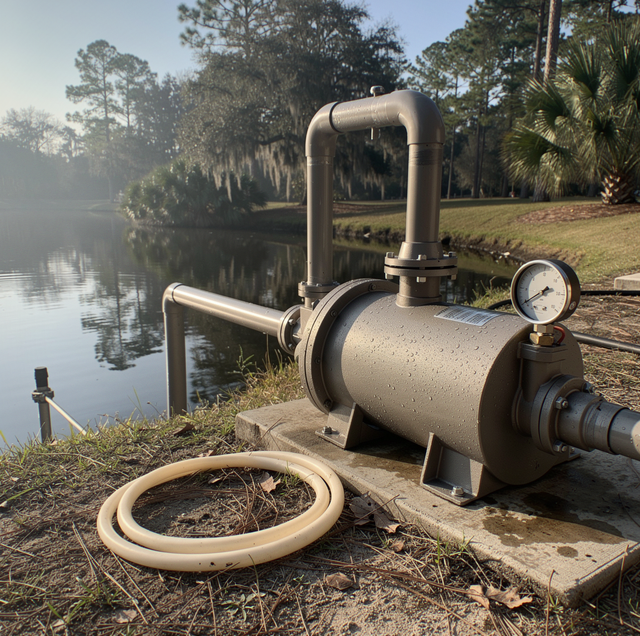
A centrifugal irrigation pump builds pressure by flinging water outward with a fast-spinning impeller. That only works if the pump housing is completely full of water, with no air pockets, and if water keeps arriving at the intake as fast as the impeller throws it out. Break either condition, and the pump spins uselessly. Understanding each way that grip can fail is what separates a five-minute re-prime from an expensive guess.
Loss of Prime: The Pump Is Pumping Air: Priming means the pump housing and the suction line are full of water before the motor starts. A centrifugal pump cannot pull air and water at the same time; air is compressible and just churns in place. When a pump loses its prime, it runs, warms up, and moves nothing.
Loss of prime usually follows a night of the pump sitting idle while water slowly drained back down the suction pipe. If the water all ran out before morning, the pump woke up full of air. You re-prime by shutting off the pump, opening the priming plug on top of the housing, and filling it with water from a hose or bucket until it overflows, then closing the plug and restarting. Never let the pump keep running dry while you diagnose; a dry centrifugal pump can cook its seals in a couple of minutes.
If the pump primes fine, runs well, then loses prime again by the next cycle, the water is escaping somewhere. That points you to the suction side or the foot valve.
Suction-Side Air Leaks: Everything between the water source and the pump inlet is under suction, meaning the pump is trying to pull a vacuum there. Any gap on that side does not drip water out; it sucks air in. A tiny leak you would never notice on the pressure side becomes a pressure-killer on the suction side.
The usual suspects are a loose or hand-tight fitting, a dried-out gasket at the pump inlet, a union that was never fully seated, or a hairline crack in the suction pipe from age or a past freeze. Thread joints assembled without fresh sealant tape are a frequent culprit.
With the pump running poorly, brush a little dish soap and water over each suction fitting. If bubbles get sucked in or the pump momentarily improves, you have found the leak. Tighten, reseal, or replace that fitting, then re-prime.
A Failed Foot Valve or Check Valve: The foot valve sits at the bottom of the suction line, down in the water. It is a one-way valve: it lets water up into the pump but is meant to hold that column of water in place when the pump shuts off, so the system stays primed. When its rubber flapper hardens, warps, or gets propped open by a stuck bit of grit, water drains straight back down every time the pump stops.
That is the signature of a bad foot valve: the pump primes and pressures up fine while you stand there, but loses prime completely between cycles. A check valve installed higher up in the line can fail the same way. Foot valves live underwater at the end of a pipe, so replacing one is more involved than swapping a fitting, and on a deeper or shore-mounted setup it is often a job worth handing to a technician.
Clogged Intake Screen or Impeller: Irrigation pumps often draw from a pond, canal, shallow well, or lake, which means they draw whatever is floating and settling in that water. The intake screen or foot-valve strainer is the first line of defense, and it clogs with leaves, algae, and silt. A blocked screen starves the impeller: water cannot arrive fast enough, pressure sags, and the pump may cavitate with a rattling, gravel-in-a-can sound.
Sand and fine grit are worse, because they slip past the screen and pack into the impeller vanes or lodge in the narrow clearance around the impeller. A partially blocked impeller cannot move its rated volume. Clearing the intake screen is homeowner work; opening the pump volute to clean packed debris from the impeller is a wetter, more mechanical job, and if the pump has to be opened, it is a good moment to have the impeller inspected.
A Worn or Eroded Impeller and Wear Ring: An impeller is a plastic or metal disc with curved vanes, and it wears. Years of pumping gritty surface water sandblasts the vane edges until they are rounded and thin. A worn impeller still spins, but it slings water with far less force, so top-end pressure falls off even when everything else is spotless.
The wear ring is the close-fitting collar between the impeller and the housing that keeps high-pressure water from leaking back to the low-pressure inlet. As it erodes and the gap widens, more water short-circuits internally, and less makes it to your sprinklers. This kind of slow decline is the reason a pump that primes correctly, has no air leak, and draws through a clean screen still cannot reach the pressure it made when it was new. Impeller and wear-ring service is pro work; it means opening the pump and matching exact replacement parts.
An eroded impeller behaves a bit like a paddle worn down to a stub: the arm swings just as fast, but each stroke pushes far less water than a full blade would.
Air-Binding in the Pump or Lines: Air-binding is different from losing prime. Here the pump has water, but a trapped pocket of air sits high in the housing or in a run of pipe that rises and dips, and that pocket refuses to move. The impeller spins against a cushion of air it cannot compress its way through, and pressure never climbs.
This shows up on systems with a high spot in the plumbing or after any repair that lets air into the lines. The fix is to bleed the air: open the priming or air-release plug with the pump off, let trapped air escape as you top off with water, and cycle the pump so the air works its way out. A properly placed air-release valve at a system high point prevents it from recurring.
A Water Source That Dropped Below the Intake: Sometimes the pump is flawless, and the water simply is not there. A pond or shallow well level can fall until the foot valve is sucking a mix of water and air, or drawing in silt from the bottom. Heavy irrigation demand, a low aquifer, or a drawn-down surface source all do this, and it happens in dry stretches as well as after a run of heavy use that outpaces recovery.
A pump that runs strong early then fades as the source draws down, or that only struggles during peak watering, points here rather than at the pump itself. The remedy is to lower the intake, extend the suction line to deeper water, or space out watering so the source can recover. If a shallow source keeps failing, a deeper well or a different water supply may be the real answer.
Irrigation Pump Versus Potable Well Pump
It helps to know which machine you are dealing with, because the fixes differ. An irrigation or sprinkler pump is usually an above-ground centrifugal or jet pump that sits by the water and pushes surface water or shallow-well water to your zones. It is built for high flow, it is easy to reach, and priming, screens, and foot valves are all part of its normal life.
A potable well pump that feeds your house is often a submersible unit hanging deep in a drilled well, pushing water into a pressure tank for drinking and household use. It rarely needs priming and is not something you pull up casually. If your low-pressure trouble is at indoor faucets rather than at sprinkler heads, you are likely dealing with the household well system, a pressure tank, or a pressure switch, not the irrigation pump. Matching the symptom to the right machine keeps you from re-priming a pump that was never the problem.
Matching Pump Size to Your Zones: A pump can be mechanically perfect and still seem to "not build pressure" if it was never big enough for the job. Every sprinkler zone demands a certain flow at a certain pressure, and a pump has a fixed curve: the more water you pull, the lower the pressure it can hold. Ask it to feed too many heads at once, and pressure collapses across all of them.
If pressure is fine on a small zone but dies whenever a big zone runs, the pump may be undersized for that zone, or two zones may be opening together when they should not. Splitting a large zone into two, correcting a valve that opens out of sequence, or sizing a replacement pump to the largest single zone's flow demand usually solves what looked like a failing pump. This is worth checking before assuming the pump is worn out.
Frequently Asked Questions
A centrifugal pump running dry can score its mechanical seal and warp plastic internals in as little as two to three minutes, because the water it normally moves is also what carries heat away from the seal faces. If you start a pump and see no pressure within about 30 seconds, shut it off rather than letting it keep spinning. Motors on these pumps are not internally cooled by airflow the way a fan-cooled tool is, so a dry run heats up fast.
This is usually a two-sided seasonal story rather than a pump defect. In cooler, wetter months, the water source sits high, and the foot valve draws clean water; through a dry, heavy-watering stretch, the source draws down, and the foot valve starts pulling air or silt. The very same source can also freeze-crack a suction fitting in a cold snap, causing an air leak that only shows up later. Track the water level at the intake across the year, because the pump often is not the thing that changed.
Yes, and running a hose into the open priming port is often easier than a bucket because it also helps push air back down the suction line and out through the foot valve. Let it run until water overflows steadily with no bubbles, which can take a few minutes on a long suction run. Do not, however, rely on hose pressure to "force" a stubborn pump to pump; if it will not hold prime after filling, you have a leak or a bad foot valve to find, not a fill problem.
It does both, because on a centrifugal pump flow and pressure are linked. A restricted intake starves the impeller of water, and a half-fed impeller cannot generate its full discharge pressure; you often hear cavitation, a distinctive crackling like the pump is chewing gravel, before the pressure fully drops. Clean the screen at the start of every watering season and after any storm that dumps debris into a pond or canal source, since a screen can go from clear to choked in a single event.
A healthy jet or centrifugal irrigation setup with a good foot valve should hold prime for days, not lose it nightly. Losing prime overnight means the water column is draining back, so the foot valve is leaking, a check valve has failed, or there is a slow suction-side air leak that only empties the line when the pump is idle. A small measured drop over a week can be normal on a long run; complete loss by morning is a repair, not routine.
Run the soap-bubble test on every suction fitting first, and fully re-prime with the source known to be high. If the pump then makes strong pressure but only for a short burst, suspect a leak or foot valve. If it primes solidly, holds prime, draws through a clean screen, and still tops out well below the pressure it once reached, with no air noise, the impeller or wear ring is the likely wear item. That process of elimination saves you from opening a pump that only needed a fitting tightened.
Get your irrigation pump diagnosed before a dry run ruins the seals — a quick check now keeps your zones spraying all season. Pump Repair Services serves Orlando, Winter Park, and Apopka. Call (407) 625-5499.