What a Pitless Adapter Is and the Job It Quietly Does
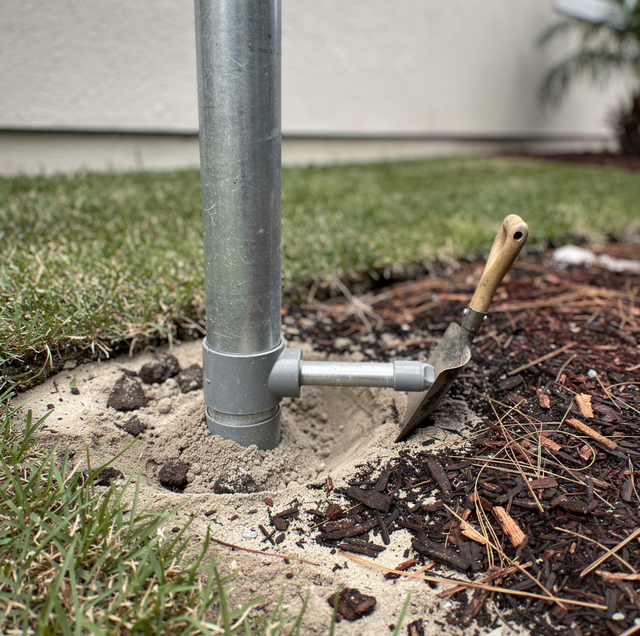
Quick Answer: A pitless adapter is the fitting on your well casing that carries water from the vertical drop pipe (the pipe hanging down to the submersible pump) over to the horizontal supply line buried below the frost line, running toward the house. It does this while sealing the casing so surface water, dirt, and bacteria cannot get into the well. It is a water-routing connector and a sanitary seal in one part.
If you have a private well, there is a good chance you have never seen the one fitting that keeps your water safe and your supply line from freezing. It hides a foot or more below the surface, bolted through the side of your well casing, doing two jobs at once. Understanding what it does makes the difference between guessing at a water problem and knowing where to look.
What a Pitless Adapter Actually Does
Start with the two-job description, because it explains everything else about the part. Water comes up from the submersible pump through a vertical pipe called the drop pipe. That pipe runs straight up the inside of the steel or plastic casing that lines your well. Somewhere below ground, that rising water has to turn 90 degrees and head sideways toward the house through a buried supply line. The pitless adapter is the fitting that makes that turn happen, sealed and underground.
The second job is just as important. A well casing is an open pipe sticking up out of the ground with a hole drilled through its side for the supply line. That side hole is a weak point. Rain, lawn runoff, insects, and soil bacteria all want to get in there. The pitless adapter seals that penetration watertight, so the only thing crossing the casing wall is clean water inside the fitting, and nothing from outside can seep in around it.
So the part routes water and protects the water at the same time. Everything that follows (why it sits deep, how a tech uses it, what a leak means) comes back to those two jobs.
The Problem It Solved: Getting Rid of the Well Pit
Older wells did not have this part. Instead, they had a well pit, which was a buried concrete or block vault dug around the top of the casing. The pit gave a worker room to reach the pipe connection below the frost line without the pipe freezing. It worked, until it did not.
A pit is a hole in the ground next to your drinking water. Groundwater seeps into it. Heavy rain floods it. Frogs, rodents, and runoff collect in the bottom. Any of that standing water sitting right at the exposed casing joint could work its way into the well. Well pits became one of the most common causes of bacterial contamination in private water systems, which is why most health codes now prohibit them on new wells.
The pitless adapter fixed the problem by moving the pipe connection out of an open vault and sealing it directly into the casing wall underground. There is no longer a hollow space collecting water beside your well. The connection is made where the casing is solid, and it is sealed. Same goal as the pit (a frost-free connection below grade), without the flooding vault that could poison the supply.
How the Two-Part Sliding Fitting Works
The clever part of the design is that it comes apart. A pitless adapter is a two-piece fitting that slides together vertically.
The stationary half bolts through a hole cut in the side of the casing. A threaded body passes through the casing wall, and a large nut or flange on the outside clamps it tight against a rubber gasket. This half never moves. The buried supply line to the house connects to its outer side.
The sliding half is a machined block that mates to the stationary half with a dovetail or tongue-and-groove track. The drop pipe from the pump threads into the top of this sliding half. When it is dropped down into the casing, it slides onto the stationary half and seats, connecting the water path.
Here is why the split design matters for service. When a technician needs to pull the pump, they thread a length of pipe or a special threaded rod called a pull rod into the top of the sliding half, then lift straight up. The sliding half releases from the stationary half, and the whole assembly (drop pipe, wiring, and the submersible pump at the bottom) comes up the casing as one column. Reinstalling reverses it: lower the string until the sliding half re-seats. No digging, no vault, no disturbing the sealed casing penetration.
The Sanitary Seal and Why the O-Rings Matter
The two halves do not just touch. Where the sliding half meets the stationary half, one or more O-rings form a watertight seal so pressurized water inside the fitting cannot leak out into the annular space of the casing, and nothing from the casing can be drawn back into the water path. Those O-rings are the seal that keeps the pressurized supply water contained at the joint.
These rubber O-rings are wear parts. Over years underground, rubber can harden, take a set, or crack.
Replace the O-rings whenever the pump is already pulled, and the sliding half is out, since the part is exposed and a fresh seal is easy to fit then. A worn seal is a slow leak waiting to happen underground where you never see it.
The casing gasket, the rubber seal on the outside where the stationary half clamps to the casing, is the other half of the sanitary barrier. Together the O-rings and that gasket are what let the fitting cross the casing wall without ever giving surface contamination a path in.
Why It Sits Below the Frost Line
The whole reason for burying the connection is temperature. Water in a pipe that freezes expands and can split the pipe or crack a fitting. The frost line is the depth to which the ground reliably freezes in a given area; below it, soil temperature stays above freezing year-round.
A pitless adapter is installed so the horizontal supply line leaves the casing below that depth. The buried run to the house stays warm enough to keep flowing through the coldest nights, and the sideways turn happens where cold cannot reach it. This is a year-round design choice, not a seasonal one. The same depth that stays below a hard freeze also holds the buried line at a stable, cool temperature in hot weather, which is easier on the pipe and the water.
Where the ground barely freezes, the frost line is shallow, so the adapter sits only a foot or two down. Where the ground freezes deep, it may sit several feet down. Either way, the principle is the same: put the connection where the ground protects it.
Signs Your Pitless Adapter Has a Problem
Because the part is buried, trouble usually shows up indirectly. A few patterns point toward the adapter or its seals.
Wet ground or a leak near the casing: Soggy soil, a soft spot, or visible water pooling around the well head can mean water is escaping at the fitting instead of reaching the house. A leak there wastes pump run time and can undermine the soil around the casing.
Pressure loss you cannot explain: If the pump runs but pressure at the house sags, or the pump short-cycles, water may be leaking out at the joint before it ever gets to the supply line. A tired O-ring or a sliding half that is not fully seated can bleed off pressure underground where you never see it.
Signs of contamination: Cloudy water, a sudden change in taste or smell, or a bacteria test that comes back positive can point to a compromised casing seal letting surface water in. This is the failure the pitless adapter exists to prevent, so a contamination result should always put the casing penetration on the list of suspects.
None of these confirm the adapter by themselves, since pressure and water-quality problems have several possible causes. They are the cluster that tells a technician to check the fitting, the seals, and the casing penetration.
Pulling the Pump Uses the Pitless Adapter
When your well needs service (a failed pump, a leak downhole, a wiring fault), the pitless adapter is the access point. The technician removes the well cap, threads a pull rod into the sliding half, and lifts the entire pipe column out through the top of the casing. That is only possible because the adapter is designed to release.
This is firmly professional work, and not only because of the part. The drop pipe, wiring, and pump together can weigh hundreds of pounds and may hang a hundred feet or more down the casing, so lifting it safely takes the right equipment and footing.
The pump runs on high-voltage wiring that must be handled correctly, and the drop pipe, wiring, and pump together can weigh hundreds of pounds, hanging far down the casing. The well cap should never be removed casually, since an open casing is both a contamination risk and an entrapment hazard. After any service that opens the well, disinfect the well and test the water before trusting it again.
The takeaway is simple. That small fitting on the side of your casing is the reason your well can be serviced from above without digging, and the reason surface water stays out of your drinking water. It earns its keep quietly, which is exactly why it is worth knowing it is there.
Frequently Asked Questions
Cutting the hole for a pitless adapter takes a hole saw sized to the fitting and, in practice, a well casing that is already exposed, and the fit has to be clean, or the casing gasket will not seal. Most jurisdictions also require well work to be done by a licensed contractor and the finished job to meet a minimum setback and depth. Beyond the permitting question, the pump has to be pulled and re-hung on the drop pipe correctly, which is the heavy, high-voltage part. It is not a typical homeowner install.
The load-bearing fittings are usually cast brass or bronze, sometimes stainless steel, chosen because they resist corrosion in constant contact with water and soil. The sealing components are the rubber O-rings between the two halves and a rubber or neoprene gasket at the casing. Lighter-duty residential versions sometimes use a reinforced polymer body, but the brass and stainless designs are what you tend to see on wells expected to run for decades.
An adapter is a two-part fitting installed through the wall of a standard well casing, which is what most residential wells use. A pitless unit is a larger factory-built assembly that actually forms the top section of the casing itself, with the discharge and access built in. Pitless units are more common on larger-diameter or high-capacity wells, such as municipal or agricultural systems, where the extra size and flow capacity are needed.
It is set below the local frost line, so the depth depends entirely on climate rather than a fixed number. In mild regions, it can be as little as 12 to 18 inches; in colder regions, it can be four to six feet or more. The installer references the recognized frost depth for the area and places the horizontal outlet beneath it, which is why two wells can have the same part at very different depths.
A healthy adapter is a full-bore pass-through and does not restrict flow, so it should have no effect on pressure. When it does affect pressure, it is because something has failed: a worn O-ring leaking at the joint, a sliding half that did not fully re-seat after service, or a crack in the body. In those cases, you lose pressure to an underground leak rather than to the fitting's design, which is why an unexplained pressure drop makes the adapter worth inspecting.
The brass or stainless body itself often outlives the pump, lasting several decades because it has no moving parts under load and resists corrosion. The rubber O-rings are the wear item and are the reason a fitting eventually needs attention; they are inexpensive and easy to swap while the pump is already pulled. Replacing the seals during a routine pump job is the practical way to keep the adapter sealing for the life of the well.
Get your well fitting and seals inspected before a small leak turns into a contamination problem — a quick check protects your water and your pump. Pump Repair Services serves Orlando, Winter Park, and Apopka. Call (407) 625-5499.