How Lightning Damages a Well Pump’s Electrical System
A storm rolls through, the lights flicker for a second, and the next morning the well pump won't start. There's no visible damage anywhere near the wellhead, no burn marks, no obvious break in the wiring, and that's exactly the point: lightning rarely has to strike a well pump directly to disable it. A strike anywhere on the property, or even a mile or more away on the utility line feeding the house, can send a voltage spike through the wiring that reaches the pump's motor, control box, and pressure switch long before it reaches anything visible enough to spot without a meter.
How a Strike Turns Into a Surge Without a Direct Hit
Lightning doesn't need to hit a house or a well casing to cause damage. A strike to a nearby tree, a utility pole, or even open ground can induce a voltage surge in nearby wiring through electromagnetic coupling: energy moving from one conductor to a nearby one without any physical contact between them, the same basic mechanism at work anytime current flowing in one wire induces a matching current in a separate wire running close beside it.
That induced surge travels along whatever wiring offers it a path: the service line into the house, the underground wire running out to the well, or both. By the time that surge reaches the pump's control box, it can carry thousands of volts for a fraction of a second, more than enough to punch through the insulation on a motor winding or fuse a relay's contacts closed.
A Direct Strike vs an Induced Surge
Not all lightning damage arrives the same way. A direct strike to a well casing or above-ground equipment is rare, but when it happens, the energy involved is enormous, often severe enough to visibly melt wiring, crack fittings, or blow a pressure switch apart. An induced surge is far more common and far less dramatic to look at, since the energy involved is a small fraction of a direct strike, but it's still large enough to damage sensitive components like relay contacts, capacitor plates, and motor winding insulation without leaving any outward sign that anything happened at all. Most storm-related well pump failures fall into this second category, which is part of why they're so often mistaken for a coincidental, unrelated pump failure.
What a Storm-Damaged Well System Looks Like
| Symptom | Likely Component | What's Happening |
|---|---|---|
| Pump won't start at all after a storm | Motor windings or start capacitor | Surge burned through winding insulation or fused the capacitor |
| Breaker trips repeatedly when pump tries to start | Control box relay or overload | Surge welded relay contacts or damaged the overload sensor |
| Pump runs, but no water pressure builds | Pressure switch contacts | Surge pitted or fused the switch contacts open or closed |
| Intermittent power to the pump circuit | Wire splices at the wellhead | Surge degraded insulation at a splice, causing an intermittent short |
| Nothing works anywhere in the house, not just the well | Main panel or service entrance | Surge entered through the main service line, not the well circuit |
Why the Motor Is Usually the First Thing to Go
A submersible pump's motor sits down in the well, sealed and largely protected from the elements, but it's still wired directly back to the surface through a cable that runs the full length of the well. That cable is one of the more effective paths a surge can travel, since it runs a long, largely unbroken length with no breaks to dissipate the energy along the way.
Once a surge reaches the motor, it can arc across the winding insulation, leaving pinhole-sized breaks that don't fail the motor outright but let it run hot and short out fully within days or weeks. That delayed failure is why a pump sometimes seems to survive a storm, only to quit for good shortly after.
What Happens Inside the Control Box During a Surge
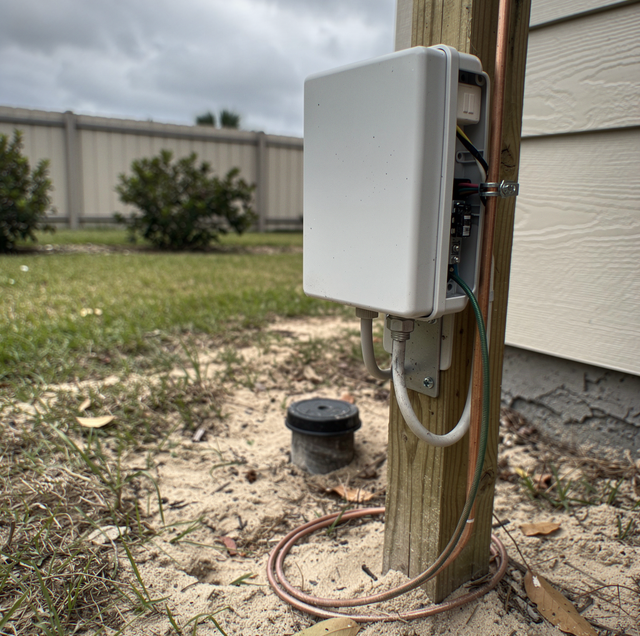
The control box is where much of the surge damage concentrates, since it's packed with components most sensitive to voltage spikes: the starting relay, the run capacitor, and, in three-phase setups, a set of contactors that switch power to the motor. A surge arriving at the control box can weld a relay's contacts shut, which then keeps feeding power to the motor even after the pressure switch calls for it to stop, or it can blow a capacitor's internal plates apart, which shows up as a motor that hums and tries to start but never actually spins up. Because these components sit close together in a small enclosure, a technician troubleshooting storm damage typically tests each one individually rather than assuming a single failure explains everything wrong.
What Surge Protection Actually Does
A dedicated surge protection device installed at the well's control panel works by providing a path to ground for a surge that the pump's wiring does not. Inside the device, a component called a metal-oxide varistor remains electrically inert during normal operation but conducts almost instantly once the voltage crosses a set threshold, shunting the excess energy to a grounding rod rather than allowing it to continue toward the motor and control box.
Pairing that with a solid grounding rod at the wellhead, one driven deep enough to maintain low resistance to earth even in dry soil, gives a surge the path of least resistance away from the equipment rather than through it.
Why Whole-House Protection Isn't Automatically Well Protection
A surge protector installed at the main electrical panel helps the house's general wiring and appliances, but it doesn't automatically protect a well pump the same way. The well circuit often runs a separate, longer path to the wellhead, and a surge can still enter that circuit downstream of a panel-mounted protector if it comes in through the ground or the well's own wiring rather than the main service line.
A pump-specific surge protection device installed directly at the well's control box or pressure switch closes that gap, giving the equipment closest to the well its own dedicated line of defense rather than relying on protection installed several dozen feet away.
What to Check After Any Nearby Storm
After a storm with close lightning, a few checks catch damage before it turns into a full outage. Listen for the pump cycling normally rather than short, rapid clicks at the pressure switch, which can indicate pitted or fused contacts. Check the breaker for the well circuit; if it trips immediately on reset rather than holding, it often points to a shorted motor winding. And if the system loses pressure gradually over a day or two rather than failing outright, that gradual decline often matches the delayed-failure pattern a partially damaged motor winding produces.
Frequently Asked Questions
Yes, and it's actually the more common way lightning damages well equipment. A strike anywhere nearby can induce a voltage surge in underground wiring or the service line without ever directly touching the well casing or pump, and that induced surge is often what reaches the motor and control box. A metal well cap or vent pipe sticking up above grade can make things worse, since it acts a bit like an antenna for nearby strikes, and a surge can also arrive through a shared grounding system if the well's ground rod is bonded to the same grounding network as the house.
It varies, but partial winding damage can let a motor run for days or even a few weeks before it fails completely, since a small insulation breach doesn't always immediately short-circuit the motor. A pump that survived last week's storm isn't necessarily undamaged. A technician can often catch this window before full failure by clamping an amp meter on the circuit; a motor drawing noticeably higher current than its rated draw is usually running hotter than it should, even while it's still producing water normally.
Not fully. A panel-mounted protector protects the house's general circuits, but the well circuit often runs on a separate path to the wellhead, where a surge can still enter. A dedicated surge protection device at the well's control box provides protection that panel-level equipment doesn't. It's also worth having an electrician confirm the well's ground rod is properly bonded to the same grounding network as the panel; a gap in that bonding can leave even a well-protected system without a clean path to ground during a surge.
It's the core component inside most surge protection devices. It remains inactive at normal voltage but conducts almost instantly once the voltage exceeds a set threshold, redirecting the surge toward a grounding rod instead of letting it travel onto the pump's wiring. A varistor also wears down a little with every surge it absorbs, even a minor one, so a device that's handled several storms over the years can have less capacity left than a brand-new one; that's why a surge protection device is worth having inspected after any major strike nearby rather than assumed to be good indefinitely.
A grounding rod gives a surge somewhere to go, but it works best paired with a surge protection device, not on its own. Without a device to redirect the surge toward the ground rod, the rod alone doesn't intercept energy already traveling through the pump's wiring. Soil condition matters too: the sandy, fast-draining soil common across Central Florida has higher electrical resistance than denser clay soil, so a single rod that would ground a well fine in one type of soil sometimes needs a longer rod, a second rod, or a grounding enhancement compound to reach the same low resistance in sandier ground.
Yes. The pressure switch has physical contacts that can pit, weld shut, or burn open under a voltage surge, and that kind of damage doesn't always show up as a total pump failure. A pump that runs but never builds proper pressure after a storm often has switch damage rather than motor damage. A technician usually checks this with a pressure gauge, watching the exact psi where the pump kicks on and off; pitted contacts often shift those cut-in and cut-out points away from where the switch was originally set, even when the pump itself is running fine.
The next time a storm rolls through with lightning nearby, treat it as a cue to check the well system before problems show up on their own, not just a reason to reset a tripped breaker and move on. A surge that pits a switch contact or scars a motor winding does its damage quietly, and the pump often keeps running, just not for long. Having the system checked after any storm with nearby lightning, and running dedicated surge protection at the wellhead rather than relying on whole-house protection alone, catches that kind of damage while it's still a repair rather than a full pump replacement.
Had a storm roll through, and now your pump's acting up? — Get a full electrical check on your well system, from the motor to the pressure switch, before a small surge becomes a full failure. Pump Repair Services serves Orlando, Winter Park, and Apopka. Call (407) 625-5499.