Well Water That Smells Like Rotten Eggs? What the Gas Means
The rotten-egg smell at your tap is not coming from the water. It is a gas. Hydrogen sulfide dissolves in underground water, remains invisible and under pressure, and breaks free into the air the instant the flow hits your sink or showerhead. Your nose is remarkably good at catching it: a few parts per billion, far below any level you could taste, is enough to fill a bathroom with that struck-match, boiled-egg odor. So the first thing to understand is that you are smelling a gas escaping the water, not something floating in it.
Hydrogen sulfide forms wherever sulfur and a shortage of oxygen meet. Around a private well, two very different engines produce it, and telling them apart is the whole job. One is alive: bacteria living in the oxygen-poor groundwater and inside your plumbing. The other is a chemical reaction happening inside your water heater. They call for completely different fixes, so before anyone sells you a filter, the source of the smell needs to be traced.
The Bacteria That Breathe Sulfate
Deep groundwater usually holds little to no oxygen. Certain bacteria have adapted to live there by doing something unusual: instead of breathing oxygen, they strip it off dissolved sulfate, a common sulfur compound in many aquifers, and release sulfide as a byproduct. These sulfate-reducing bacteria are not a sign of filth and are generally harmless to touch or handle. They simply do what they do best in dark, still, low-oxygen water, and the sulfide they give off is what you smell.
Aquifers that sit in sulfur-bearing rock or hold decaying organic matter feed these bacteria well, which is why one well reeks and a neighbor's a mile away runs clean. Once established, the bacteria coat the inside of the well casing, the drop pipe, the pressure tank, and the household plumbing in a thin, slimy biofilm that continues to generate gas long after the water leaves the ground. Iron and sulfur tend to travel together in well water, so the same water that leaves rusty-orange stains in the toilet tank often carries the sulfur smell as well. A water softener alone does nothing for either one, a point worth remembering before you blame the salt.
When the Smell Lives in Your Water Heater
The single most useful test you can run costs nothing. Turn on a cold tap and smell it. Then run the hot. If only the hot water smells, your well is probably innocent, and the problem is sitting in your water heater.
Every conventional tank heater contains a sacrificial anode rod, a long metal rod threaded into the top of the tank. It is meant to corrode in place of the steel tank, giving itself up so the tank lasts longer. Most rods are magnesium; some are aluminum. In hot water that carries a little sulfate and the right bacteria, the magnesium rod's own electrochemistry drives the reaction that produces hydrogen sulfide. The tank becomes a small gas generator, and every hot shower carries the result. Cold water, which never touches the rod, comes through fine. That hot-only split is the clearest single clue in the whole diagnosis.
Tracing It Back: Hot, Cold, One Faucet or the Whole House
Before treating anything, walk the smell down with a few quick checks. Each one narrows the source.
Hot side only, or both? Hot-only points to the water heater and its anode rod. If cold water smells too, the gas is coming from the well or from bacteria colonizing the whole system.
One fixture, or every tap? If a single sink smells and the rest of the house is clean, the problem is local: biofilm in that faucet's aerator, a drain trap breathing back at you, or a dead leg of pipe where water sits. If every tap smells, including an outdoor spigot, the source is upstream of the house.
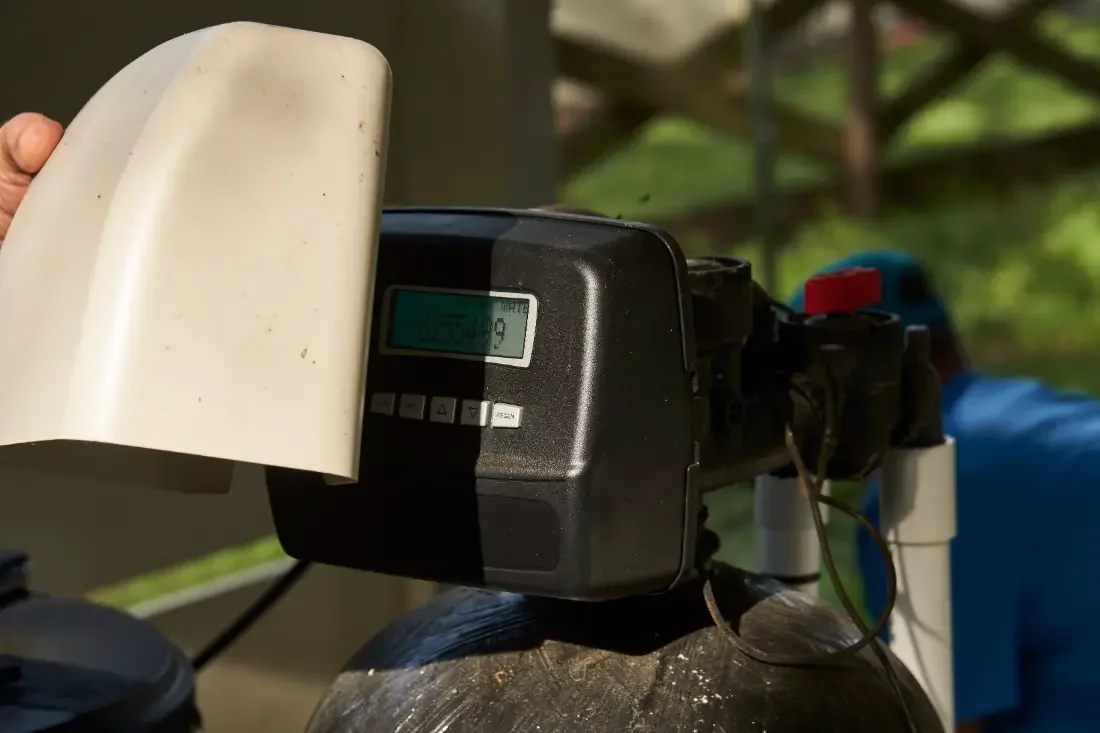
Softened or unsoftened water? If you have a softener, smell an outdoor hose bib (usually plumbed ahead of the softener) and compare it to a treated indoor tap. A softener's resin bed is a dark, wet, nutrient-rich place, and sulfate-reducing bacteria will happily set up shop inside it. When the unsoftened water is clean but the softened water stinks, the softener itself has become the reactor.
Worse after the water sits? A smell that is strong first thing in the morning, then fades after you run the tap for a minute, points to bacteria multiplying in still water overnight rather than a steady source in the aquifer.
Run those four checks, and you will usually know whether you are dealing with the heater, the well, a single fixture, or the softener before a technician ever arrives.
Clearing It: Match the Fix to the Source
There is no single cure, because there is no single cause. The fix has to match the source of the gas.
If the smell is hot-water-only, the answer is at the heater. Swapping the magnesium anode rod for an aluminum-zinc alloy rod usually stops the reaction, and a powered (impressed-current) anode, which protects the tank with a trickle of electricity instead of a dissolving metal, sidesteps the reaction entirely. Flushing and disinfecting the tank clears the bacteria already inside.
If the whole house smells, the well and plumbing need to be knocked back and then kept clean. Shock chlorination is the reset: a strong chlorine solution is circulated through the well, the pressure tank, and every line, held long enough to kill the bacteria, then flushed out. It works, but it is a reset, not a cure. Bacteria drift back in from the aquifer, so wells that smell again within weeks usually need continuous treatment rather than repeated shocking.
For dissolved hydrogen sulfide steadily coming from the ground, continuous treatment means oxidizing the gas from the water and filtering the result. The common paths:
| Where the gas comes from | Tell-tale sign | Typical fix |
|---|---|---|
| Water heater only | Hot water smells, cold does not | Aluminum-zinc or powered anode rod, flush the tank |
| Whole house, off the well | Cold and hot both smell | Shock chlorination, then a continuous filter |
| Low, steady odor | Faint but always there | Catalytic carbon filter |
| Sulfur plus orange staining | Rotten egg and rusty water together | Air-injection oxidizing filter or manganese-dioxide media |
| A single tap or the softener | Only one fixture, or only softened water | Clean the aerator or disinfect the resin bed |
An air-injection oxidizing filter draws a pocket of air into a tank, lets the oxygen convert the sulfide into tiny particles of elemental sulfur, then traps those particles in a bed of media and rinses them away on a backwash cycle. It handles moderate to high sulfide and does well when iron accompanies it. A catalytic carbon filter, built on a specially processed activated carbon, is the quieter option for low concentrations: it speeds the breakdown of the gas and holds it in the carbon until the media is spent and needs replacing. Filters built on manganese dioxide media oxidize iron, manganese, and sulfide simultaneously and suit water fouled by all three. For very high levels, a metered dose of oxidizer ahead of the filter does the heavy lifting. A technician typically measures the water's oxidation-reduction potential (ORP) to judge how much oxidizing power the water actually needs, so the system is sized to the water rather than guessed at.
One thing every option here has in common: a water softener is not among them. Softeners trade hardness minerals for sodium through ion exchange and have no effect on dissolved gases. Sulfur treatment goes ahead of the softener, both to do the job the softener cannot and to protect the resin bed from the bacteria.
Frequently Asked Questions
At the low levels most wells produce, hydrogen sulfide is a nuisance rather than a health hazard, and there is no federal health-based limit for it, only a recommendation based on taste and odor. It is not harmless to your house, though: the gas tarnishes silverware black, darkens copper and brass fittings, corrodes steel, and can leave dark stains in fixtures. A strong sulfur smell is also often associated with high sulfate levels, which can have a laxative effect on visitors and infants not used to it. Because the odor can mask other problems, a lab test for hydrogen sulfide, sulfate, iron, and bacteria is the honest starting point before you spend on equipment.
Shock chlorination kills the bacteria present on the day you do it, but it does not change the water coming in behind them. Sulfate-reducing bacteria live in the aquifer itself and re-enter the well continuously, so a system that smells again in a few weeks is telling you the source is ongoing, and a one-time disinfection cannot hold it. Recurrence within days rather than weeks points to a large reservoir of biofilm in the pressure tank or to a poorly sealed well cap that lets surface water and bacteria back in. That pattern is the signal to move from repeated shocking to a continuous oxidizing filter, and to have the well cap and sanitary seal checked.
Probably not, and the difference matters because the treatment differs. An oily or asphalt-like smell usually points to manganese rather than hydrogen sulfide, and a musty, earthy, or moldy odor more often comes from harmless organic matter or iron bacteria, which leave a slimy orange residue rather than a gas. A smell closer to sewage that only shows up at one drain is usually the drain itself, not the water, and it disappears if you fill a glass and sniff it in another room. Matching the exact odor to the right cause keeps you from buying a sulfur filter for a manganese problem.
Not on its own, and the sharper question is whether the softener has quietly become the source. There is a tell you can smell for yourself: run an outdoor hose bib plumbed ahead of the softener, or put the unit in bypass, and compare it to a softened indoor tap. If the untreated water is nearly odorless while the softened water reeks, the resin bed is the reactor, not the aquifer, because the warm, dark, nutrient-rich resin is a comfortable home for sulfate-reducing bacteria. Cleaning it out means more than a routine regeneration: run a resin-safe sanitizer through a full manual regeneration so it contacts the whole bed, either an unscented plain-chlorine dose metered into the brine tank or a peroxide-based resin cleaner made for the job, and repeat if the smell creeps back. Then place any real sulfur treatment ahead of the softener, an oxidizing filter working on the raw well water, so it pulls the gas out before the resin ever sees it and keeps the bed from re-fouling. The softener by itself only trades hardness for sodium, leaving the dissolved gas untouched.
Removing the anode rod usually stops the smell, but it is a poor trade: the rod exists to corrode in place of the tank, and pulling it out leaves the bare steel to rust through years sooner and voids most tank warranties. The better move is to swap the magnesium rod for an aluminum-zinc alloy rod, which produces far less sulfide, or to install a powered anode that protects the tank with a small electric current and lasts its whole life. Softened water accelerates anode consumption, so a home with a softener may need to replace rods more often, regardless of the smell.
Not by itself. Hydrogen sulfide is produced by geology and by naturally occurring sulfate-reducing bacteria, and it is not evidence of sewage or fecal contamination. A new sewage-like smell that appears suddenly, especially after heavy flooding or a drop in the water table, is a different concern and worth a coliform bacteria test to rule out surface water entering through a damaged cap or casing. The rotten-egg odor and true contamination are separate questions, which is why testing tells you far more than smell alone.
What the Smell Is Really Telling You
A rotten-egg smell is less of a problem in itself than a sign of your water. It tells you sulfur is present, that oxygen is scarce where the water sits, and that either bacteria or your water heater is turning that chemistry into a gas. Because iron, manganese, hardness, and acidity often ride along in the same well, the smart order of operations is to test the water first, identify everything it carries, and then build a treatment stack matched to that specific water rather than to the smell alone. Chase the odor with the wrong single gadget, and it keeps coming back; match the fix to the actual source, and it stays gone.
Get the source of the smell pinned down before buying equipment - a test for hydrogen sulfide, iron, and sulfate, a check of the water heater against the well, and the right anode fix or oxidizing filter matched to your water. Pump Repair Services serves Apopka and the surrounding Central Florida area. Call (407) 625-5499.