Well Pump Clicking On and Off? Why It Short Cycles
You crack the kitchen tap for a glass of water, and you hear it start up under the house or out in the well room: click, hum, click. The pump kicks on, runs for two or three seconds, snaps off, and a breath later kicks on again. On, off, on, off, faster than any pump should ever cycle. You have not changed a thing about how you use water, but the whole system sounds like it is stuttering.
That rapid on-off pattern has a name in the trade: short cycling. It is not a quirk you can live with, because every one of those starts is hard on the motor. The good news is that the causes are a short, knowable list, and most point to one inexpensive part rather than the pump itself.
The Clicking Has a Name, and a Cause
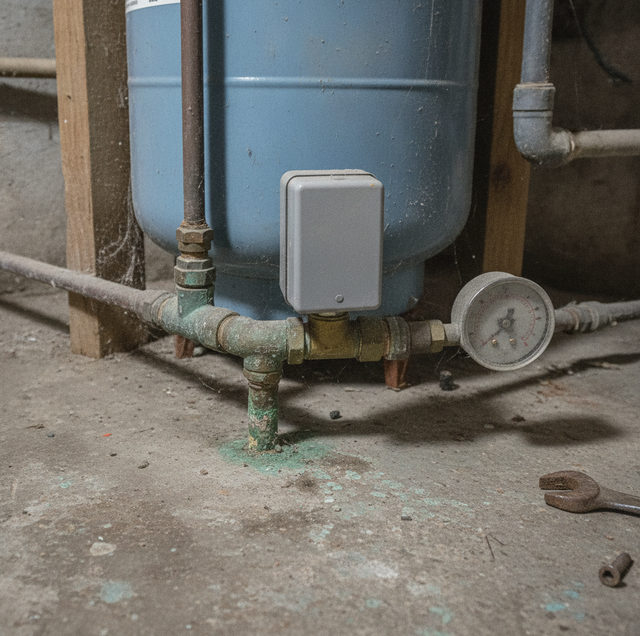
To see why short cycling happens, you have to know what your pump is actually chasing. It is not trying to keep water flowing on demand. It is trying to keep a pressure tank charged between two set points. A pressure switch turns the pump on at a low number, the cut-in, and off at a high number, the cut-out. Common pairs are 30/50, 40/60, or 20/40 pounds per square inch. The pump runs only long enough to climb from cut-in to cut-out, then rests.
The pressure tank is what lets it rest. Inside a modern tank is a rubber bladder with a cushion of compressed air behind it. As the pump pushes water in, the air squeezes; when you open a faucet, that squeezed air pushes water back out without the pump running. The volume you draw between cut-out and cut-in before the pump has to restart is called drawdown, and a healthy tank hands you several gallons of it.
Short cycling is what you get when that drawdown collapses to almost nothing. The pump hits cut-out, you draw a cup of water, pressure falls straight back to cut-in, and the pump fires again. The cushion that was supposed to carry you between starts is gone. Find why it disappeared, and you have found your problem.
Quick Reference: Matching the Symptom to the Cause
Before the deep dive, here is how the common patterns line up. Match what you are seeing or hearing to the likely cause and the next step.
| What you notice | Likely cause | What to do |
|---|---|---|
| The pump snaps on and off every few seconds while the water runs | Waterlogged tank: lost air charge or ruptured bladder | Have the tank precharge tested, then recharge or replace it |
| Pump cycles even with every faucet closed | Back-leak at the foot valve, check valve, or drop pipe | Have the check and foot valve tested for bleed-down |
| The gauge needle snaps fast between two numbers | Pressure switch set too narrow, or pitted contacts | Have the switch inspected and the cut-in/cut-out spread verified |
| Water sputters, flow drops, then the pump races | Clogged intake screen or worn impeller | Have the intake, screen, and pump end checked |
| A new, stronger pump cycles on the old, small tank | Pump oversized for the tank's drawdown | Match the tank drawdown to the pump; a larger tank often helps |
The Waterlogged Pressure Tank
This is the cause behind most short cycling calls, so it belongs at the top of the list even though it is not this article's focus. A tank is waterlogged when it fills with water and loses its air cushion. With the air gone, nothing springs water back out, so the drawdown drops from gallons to a splash, and the pump restarts almost the moment it shuts off.
The air disappears in two ways. In a bladder tank, the rubber can rupture or develop a pinhole after years of flexing, letting water flood the air side. In an older galvanized tank without a bladder, air and water sit in direct contact, and the air slowly dissolves into the water and gets carried off down the line. Confirming it means testing the precharge at the air valve with the system drained, a check worth its own walkthrough. From here, the focus turns to the causes that get misread as a dead tank, because those are the ones homeowners chase longest after a new tank fails to fix the cycling.
When the Pressure Switch Is the Culprit
If the tank checks out, the switch is the next suspect. The pressure switch is a small gray box, usually mounted near the tank or the pump, with electrical contacts inside that open and close as pressure rises and falls. Two failures inside it cause cycling.
The first is a narrowed span. If the gap between cut-in and cut-out shrinks, say from a 20-point spread down to a few points, the pump has almost no room to work and trips off and on in a tight band, often from a weakening spring inside or a botched adjustment. The second is a clogged sensing port. The switch reads pressure through a small opening, and iron, sediment, or mineral scale can pack that port or the tube feeding it. A partly blocked port sees pressure changes late and erratically, so the switch chatters. Wells carrying a lot of dissolved iron or fine grit foul that port the fastest.
A Hidden Leak Below the Surface
Here is the tell that sends you looking underground: the pump cycles even when every faucet, toilet, and hose bib in the house is shut off. If nothing is drawing water and pressure still bleeds down enough to trip the pump, water is escaping somewhere it should not, and the pump keeps restarting to make up the loss.
The usual escape point is the check valve or foot valve. A foot valve sits at the bottom of the drop pipe down in the well and holds the water column up so it cannot drain back. A check valve does the same job higher in the line. When either one wears out or catches a piece of grit on its seat, water siphons back down the well, pressure drops, and the pump fires to refill. A cracked drop pipe or a leaking fitting does the same thing. Because this leak is out of sight, it is the cause homeowners chase the longest, often replacing the tank first and staying puzzled when the cycling continues.
Clogged Intake or a Pump That Is Simply Too Big
Two less common causes round out the list. The first is a restriction at the pump itself. If the intake screen is packed with sand or the impellers wear down, the pump struggles to build pressure, and its behavior turns erratic, sometimes racing and cycling as the flow sputters. Wells drawing through sandy or sediment-heavy formations send fine grit at the intake and screen, wearing the pump end and clogging screens faster than in clean rock, so this shows up as gritty, sputtering water alongside the cycling.
The second is a mismatch you would never guess: an oversized pump. If a pump was replaced with a stronger one but the tank stayed the same, the pump can refill the tank's small drawdown so quickly that it slams from cut-in to cut-out in seconds, only to restart the moment you draw again. The pump is not broken; it has outgrown the tank. The fix is matching the tank's drawdown to the pump's output, which usually means a larger tank.
Why You Should Not Just Let It Run
It is tempting to shrug off the clicking and deal with it later. Do not. A pump motor draws a heavy surge of current every time it starts, far above its normal running draw, and short cycling multiplies those starts from a handful an hour into dozens a minute. That constant hammering is what turns a small, cheap fault into a failed motor. Catching the cycling early is the difference between swapping a tank or a switch and replacing the whole pump.
Frequently Asked Questions
Watch the pump with every fixture in the house closed. A waterlogged tank only cycles while you are actually drawing water, so with all taps shut, it goes quiet. A leaking foot valve or check valve keeps bleeding pressure back down the well, even with nothing open, so the pump kicks on by itself every few minutes in dead silence. Time the gap between those unprompted starts: a steady, repeating interval points at a valve siphoning the water column back down, and the longer the pump has been parked, the more pressure it will have lost before it fires. You can narrow it further if there is a check valve you can reach above ground. Close the shutoff between the tank and the wellhead and see whether the phantom cycling stops, which tells you whether the leak is above that valve or down at the foot valve in the well.
It does real damage, and the reason is specific. Submersible motors rely on the water flowing past them to carry off heat, and they are rated for only a limited number of starts per day, often a few hundred. Rapid cycling blows through that budget in an afternoon, and the brief runs never move enough water to cool the motor between starts. The parts that fail first are usually the start capacitor and the pressure switch contacts, which pit and burn from arcing on every start, but a motor cooked by repeated hot restarts is the expensive ending.
A modern tank has a rubber bladder that keeps the air charge physically separated from the water, so the air cannot dissolve away. Older galvanized tanks store air and water in direct contact with no barrier, which lets the air slowly absorb into the water and escape down the line. To fight that, those tanks use an air-volume control, and on many a snifter valve near the pump meters a small gulp of air into the line on each start so the control can top the cushion back up. That gives you a way to separate two failures: a galvanized tank that waterlogs gradually and recovers once the air control is cleaned or the snifter freed usually has a fouled air-metering system, while a tank that refuses to hold any air you add has lost its seal, a torn bladder on a modern tank, and needs replacing. The chronic waterloggers are the old galvanized type, which is why they are often swapped for a bladder tank.
A common rule of thumb is to size the tank so the pump runs at least a minute per cycle rather than seconds. The usable drawdown depends on tank size and the switch settings, but a properly charged tank should deliver several gallons before the pump restarts, not a cup or two. If your pump runs and stops in seconds, the effective drawdown has collapsed, which points back to a lost air charge or a tank too small for the pump feeding it.
Only if the tank was the actual cause. A larger tank adds drawdown and lengthens the run time, which solves cycling from a small or waterlogged tank and from an oversized pump. But if the real problem is a leaking foot valve or a fouled pressure switch, a bigger tank only hides the symptom for a while before the cycling returns. That is why the diagnosis matters more than the part.
You can safely cut power at the breaker, but the adjustment itself is where people get into trouble. The switch terminals carry line voltage, often 240 volts, and the two adjusting nuts do different things: one shifts both cut-in and cut-out together, the other changes only the spread between them. Turned the wrong way, they can leave the pump unable to reach the cut-out and running nonstop, or with a span so narrow the cycling gets worse. Setting them correctly means reading the gauge through a full cycle, a job better left to a technician.
Putting the Clicks Together
Short cycling sounds alarming, but it is one of the more diagnosable faults a well system throws at you. It almost always traces to a lost cushion of air in the pressure tank, a switch that has narrowed or fouled, or a slow leak bleeding pressure back down the well. Each leaves its own fingerprint: cycling under load points at the tank, cycling with every tap closed points at a valve underground, and a gauge snapping in a tight band points at the switch. The one thing not to do is let the clicking run, because the motor pays for every start. Track the cause down early, and the repair stays small.
If your well pump is clicking on and off every few seconds, have it diagnosed before the motor pays the price - a technician can test the tank's air charge, the pressure switch, and the check valve to find what is really bleeding the pressure. Pump Repair Services serves Apopka and the surrounding Central Florida area. Call (407) 625-5499.