Why Does My Well Pump Run Constantly? 7 Causes to Check
A healthy well pump works in short bursts. It kicks on to refill the pressure tank, builds pressure until it hits a set number, then shuts off and rests. When the pump never rests, one of two things is true: it can't reach the pressure it's supposed to shut off at, or something keeps calling for water and draining that pressure as fast as the pump can make it. Either way, the motor is running when it should be resting, and that is worth chasing down quickly.
Quick Answer: A well pump that runs constantly is almost always either losing pressure faster than it can build it (a leak, a bad check valve, or a waterlogged tank) or unable to reach its shut-off pressure at all (a stuck pressure switch, a worn pump, a clogged filter, or a dropping water level). Start by ruling out a leak, then have a pro check the switch, tank, and pump.
How a Well Pump Is Supposed to Cycle
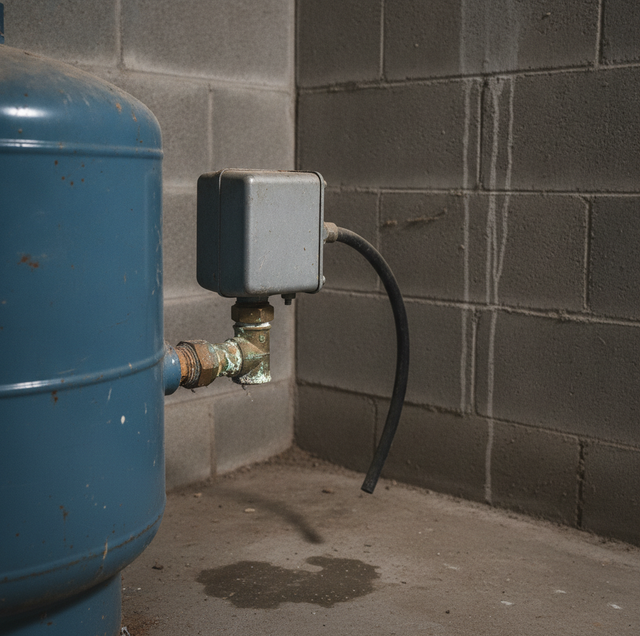
The pump feeds a pressure tank, and inside that tank, a cushion of compressed air sits above (or besides, in a bladder tank) the water. As the pump pushes water in, the air compresses and pressure climbs. A pressure switch watches that number, and when pressure reaches the cut-out setting, the switch opens the circuit, and the pump stops. You then draw water from the tank until the pressure falls to the cut-in setting, and the whole thing repeats.
Constant running means that loop never closes. Think of the cut-out number as a ceiling the pressure has to reach before the switch will let the pump rest. If the pump can't push pressure up to that ceiling, or if water keeps bleeding away as fast as it builds, the motor never gets its shut-off command. That one idea, a cut-out pressure the pump can't reach or can't hold, explains every cause below.
Something Is Draining Water Faster Than the Pump Can Refill
The most common reason for nonstop running is not a broken pump at all. It's a leak. If water is escaping somewhere in the system, pressure never builds high enough to trip the cut-out, and the pump chases a target it can't hit.
The leak can be almost invisible. A toilet flapper that doesn't seat fully bleeds tank water into the bowl around the clock, silently. A dripping outdoor spigot, a hose bib left cracked open, an irrigation zone stuck on, or a fixture with a bad washer all count. Underground, the culprit may be a cracked supply line between the well and the house, or a leaking pitless adapter, the fitting that connects the buried well pipe to the house line. A failure there dumps water into the ground where you never see it.
The check is simple. With every fixture shut off, watch the pressure gauge or the water meter. If pressure slowly falls or the meter keeps creeping, water is going somewhere it shouldn't, and the pump is running to replace it.
The Pressure Tank Has Lost Its Air Charge
The tank stores the air cushion that allows pressure to build and be held between cycles. Over the years, the charge can bleed off, or a rubber bladder inside can rupture. When the air is gone, the tank fills completely with water and becomes waterlogged. With nothing left to compress, pressure spikes and collapses the instant a tap opens.
A waterlogged tank produces one of two symptoms. Either the pump short-cycles, snapping on and off every few seconds in a rapid machine-gun rhythm, or it runs and runs because the tiny volume of pressurized water empties immediately. Rap your knuckles on the tank: a healthy one rings hollow near the top and sounds solid near the bottom. A tank that sounds full of water all the way up has lost its charge.
The Pressure Switch Never Signals Cut-Out
The pressure switch is the brain that tells the pump to stop. It has two jobs: to close the circuit at cut-in and to open it at cut-out. If it fails to open, the pump never gets the shut-off command.
Two things go wrong here. The contacts inside can pit, corrode, and eventually weld themselves closed, so current keeps flowing no matter how high the pressure climbs. Or the switch is set to a cut-out pressure that the pump physically cannot produce, setting the shut-off ceiling higher than the pump can ever reach. Diagnosing this means testing a live electrical component, a job for a technician: the switch cover carries full line voltage and should not be opened by a homeowner.
The Pump Itself Is Worn, or Its Intake Is Clogged
A pump loses capacity as it ages. Impellers wear, wear rings open up, and the ability to build pressure fades. A pump that could once reach cut-out in a minute now labors and never quite gets there, running continuously at a pressure that falls short of the shut-off point.
The intake can also choke. Fine sand, silt, or mineral scale can partially block the pump's screen or the well's flow. Less water in means less pressure out, and the shut-off ceiling stays out of reach. A worn pump and a clogged intake look alike from the gauge: pressure climbs slowly and stalls below cut-out, no matter how long you wait.
The Water Level in the Well Is Dropping
A pump can only move water that it can reach. If the water level falls below the pump's draw level, it starts drawing air along with water, and air doesn't build pressure, so the pump spins without ever reaching cut-out.
A prolonged dry stretch can lower the aquifer and expose the pump, and many regions see seasonal swings in the water table. But a dropping level is only one cause among many, and it happens the rest of the year too: heavy nearby irrigation, a shallow-drilled well, or a pump set too high in the casing can all starve a pump in any month. A gauge that shows the pump losing prime, running smoothly, then sputtering, points toward the well rather than the plumbing.
A Check Valve or Foot Valve Is Letting Water Fall Back
Somewhere in the line sits a check valve (near the pump) or a foot valve (at the bottom of the well pipe). Its only job is to let water flow up and never back down, holding the column of water in place while the pump rests.
When that valve sticks open or its seat leaks, water drains back down the well every time the pump shuts off, so the pump restarts and rebuilds the pressure it just lost, over and over. If you hear the pump kick on repeatedly when no water is being used, especially with a brief pause between cycles, a leaking check valve is a strong suspect. The pump isn't chasing a house leak; it's chasing water that keeps sliding back down the pipe.
A Clogged Filter Is Choking the Flow
A whole-house sediment filter that has been packed solid with grit restricts flow the same way a partly closed valve would. The pump pushes hard against the restriction, pressure downstream never climbs to cut-out, and the pump keeps running. This one is easy to check: pull the cartridge and see whether it's caked. A filter changed on schedule rarely causes it, but a neglected one can.
Why Running Nonstop Damages the Pump
A submersible or jet pump motor is designed to cycle: run, shut off, cool, and run again. The rest between cycles is not idle time; it's how the motor sheds heat. Take that rest away, and the motor runs hot for hours, and heat is what kills motors. A pump that runs around the clock also draws power around the clock, and the electric bill climbs with it. For both reasons, a pump that won't shut off should be switched off at the breaker until the cause is found, rather than left running while you investigate.
Diagnosing It: Leak, Tank, Switch, or Pump
The four families of causes each show up differently on the gauge, and telling them apart is most of the work.
A leak shows water going somewhere, and a system that won't build pressure with everything off. A waterlogged tank shows rapid short-cycling, or a tank that sounds solid with water top to bottom. A bad switch or worn pump shows pressure that either overshoots and never stops (switch stuck closed) or stalls below cut-out and never gets there. A dropping well shows the pump losing prime and sputtering air.
Work in that order. Rule out the free, visible stuff first (running toilets, open spigots, the meter, the filter), then hand the live electrical and mechanical diagnosis to a pro who can safely test the switch, measure the tank's air charge, evaluate the pump, and check the well's water level without opening an energized switch or pulling the pump.
What You Can Safely Check Yourself
There is a clear line between homeowner tasks and pro tasks. On the safe side, you can shut off every fixture and watch the gauge and meter for movement, dye-test toilets by adding coloring to the tank and watching for it in the bowl, walk the property for open or dripping spigots and stuck irrigation, and pull and inspect a sediment filter cartridge. None of that involves electricity or the well itself.
On the pro side sits everything that carries voltage or lives down the well. Testing the pressure switch means working on a live circuit. Checking the tank's air charge, evaluating a worn pump, inspecting a check or foot valve, and measuring the well's static water level all call for the right tools and training, and are the steps to leave to a technician.
Frequently Asked Questions
Look for something quietly draining water before you assume the pump is bad, because a leak is the most common cause of nonstop running. Check for a running toilet, a dripping fixture, and any open or leaking outdoor spigot. These bleed pressure faster than the pump can rebuild it, and finding one often solves the whole problem without touching the pump.
The switch is commonly set to cut in at 40 psi and cut out at 60 (30/50 is another typical pairing), and the pump only rests once pressure climbs to that cut-out figure. A leak that bleeds pressure down below the cut-out number as fast as the pump builds it means the pump never reaches the shut-off point, so it runs continuously until the leak is closed.
A healthy tank holds an air pre-charge that should read about 2 psi below the cut-in pressure when the water is drained out, so a 30/50 system wants roughly 28 psi of air in an empty tank. When that charge bleeds off or the bladder ruptures, the tank waterlogs, and a gauge on the empty tank reads near zero. With nothing left to compress, pressure spikes and collapses instantly, and the pump either runs nonstop or snaps on and off in rapid short-cycles.
Yes. Each time the switch opens and closes, the contacts arc slightly, and over thousands of cycles, that arcing pits the metal or eventually welds the contacts shut. Welded contacts keep the pump circuit closed even when pressure is perfectly fine, so the motor never gets its stop command. Confirming this means testing a live switch under voltage, which is a diagnosis to leave to a pro rather than opening the cover yourself.
A pump motor is built to cycle on and off with rest between runs, and that rest is how it sheds heat. Running nonstop keeps the motor hot for hours, which overheats it and wears it out early, and it drives the electric bill up the whole time. That combination is why a pump that won't shut off should be switched off until the cause is found.
Yes. A submersible setup often carries two check valves, one down at the pump and a second up near the tank, and only one has to fail for the trouble to start. If either valve fails to hold, the standing column of water falls back down the pipe whenever the pump rests, and the pump restarts to rebuild the pressure it just lost, repeating far more often than it should.
Get your well pump diagnosed before the motor burns out — a quick check now saves a full replacement later. Pump Repair Services serves Orlando, Winter Park, and Apopka. Call (407) 625-5499.