Sump or Transfer Pump Won't Turn On? Where to Start
A sump or transfer pump that will not start is almost always one of a short list of things, and most of them are not the motor. That is the useful fact to hold onto when the water is rising, and the pump sits silent: far more often than a burned-out motor, the fault is power that is not reaching the pump, a float switch that never tells it to run, a safety device that has tripped, or something jammed in the way. Those are the cheap failures, and most can be found in a few minutes. The motor is the last suspect on the list, not the first, which is exactly why it pays to work the list in order instead of assuming the worst.
Here is the reassuring part: you can work through most of those checks yourself in a few minutes. The trick is going in the right order, from the simplest and safest outward, so you rule out a stuck float or a tripped breaker before you ever start pricing a new pump. One warning before you start. Water and electricity share that pit, so kill the power at the breaker before you reach a hand anywhere near the pump or the water. Everything below assumes you have done that first.
Start Where the Power Is
Before you suspect the pump itself, prove that electricity is actually reaching it. A submersible sump or transfer pump usually plugs into a dedicated outlet, and these outlets are commonly on a GFCI. Two quick checks cover most no-power calls. First, look at the breaker panel for a tripped breaker and reset it. Second, find the outlet and press the reset button on the GFCI, whether it is on the receptacle itself or back at the panel.
GFCI outlets are worth a hard look, because a damp pit is exactly the kind of humid, splash-prone spot where they nuisance-trip even when nothing is wrong with the pump. Many sump pumps also use a piggyback plug: the float switch plug stacks on top of the pump plug, and both share one outlet. If that stack has worked loose, the pump loses its signal to run. Reseat both plugs firmly.
Power outages and voltage surges deserve a mention here, and not only during storm season. A lightning surge can pop a breaker or damage an outlet, an afternoon thunderstorm can drop the grid, and a random utility fault can do the same on a clear day. If backups matter for your basin, they matter every month of the year, not just when the forecast looks bad.
The Float Switch Is the First Real Suspect
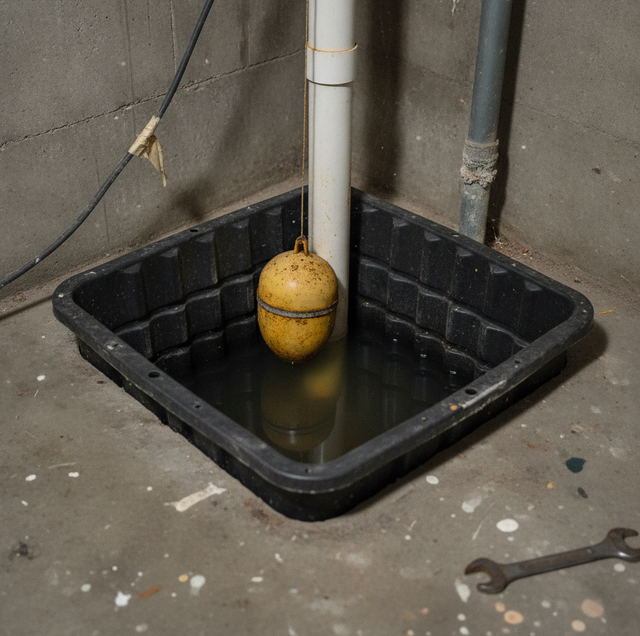
If the pump has power but stays silent while the water rises, the float switch is where the fault usually hides. This is the single most common reason a pump refuses to start. The float is the switch that senses the water level and tells the motor when to run, and it fails in more ways than any other part.
Floats come in a few designs, and knowing which one you have narrows the problem fast.
| Float type | How it works | Most common failure |
|---|---|---|
| Tethered | Floats on a cord and swings up as the water rises | Jams against the pit wall or pump body; needs room to swing |
| Vertical | Rides straight up and down a guide rod | Debris on the rod or a stuck collar keeps it from sliding |
| Diaphragm | Senses water pressure, no visible arm | The pressure port clogs with silt and stops responding |
Whatever the type, run through the same short list. A tethered float that swings can jam against the basin wall or hang up on the discharge pipe or its own power cord, especially in a narrow pit or after the pump has shifted on its base. A float can crack and take on water, which leaves it too heavy to rise: a waterlogged float sinks instead of floating. Silt and iron sludge coat the hinge or the guide rod and gum up the motion. And a tethered float is often simply set incorrectly, because the length of the tether determines how high the water must rise before the pump kicks on. Too short a tether and the float never tips far enough to close the switch.
The test takes ten seconds. Reach in with the power on only if you can do it safely, and lift the float by hand. If the pump roars to life the moment the float rises, the motor is fine, and the float or its setting is your culprit. If nothing happens even with the float raised, the problem is deeper.
A Tripped Thermal Overload
Pump motors carry a built-in guard called a thermal overload, a small bimetallic switch that cuts power the instant the windings run too hot. It exists to prevent the motor from cooking itself, so a tripped overload is the pump protecting itself from another problem.
A motor overheats when it has been fighting something: a jammed impeller, a blocked discharge line, rapid on-off cycling, or a stretch of running dry after the water dropped below the intake. Heat and humidity around the motor housing make the trip come sooner. Many overloads reset on their own once the motor cools, which can take 15 to 30 minutes, while some designs require a manual reset. The tell is a pump that runs for a few minutes, quits, sits a while, then runs again. That pattern is the overload doing its job, and it points you toward whatever is making the motor work so hard rather than the overload itself.
A Jammed or Worn Impeller
The impeller is the spinning vane inside the pump that actually moves the water. It sits right at the intake, so it eats whatever the pump pulls in. Gravel, grit, silt, and fine sandy sediment that works into a pit can wedge between the impeller and its housing, locking it in place. A jammed impeller often makes the motor hum without spinning, and that strain is frequently what trips the thermal overload.
There is a slower version of the same failure. Abrasive sediment grinds the impeller vanes down over the years, so the pump still spins but pushes far less water than it used to. If your pump has grown weak rather than gone silent, worn vanes are a likely reason. With the power off, pull the pump, check the intake screen for a mat of debris, and look for anything binding the impeller. Clearing a jam here revives a pump that looked finished.
A Stuck Check Valve or an Airlock
The check valve sits on the discharge pipe and stops water that has already been pumped up the line from draining back into the pit. When it sticks, two things go wrong. If it jams shut, the pump has nowhere to push water, so the motor labors, moves nothing, and can overheat into an overload trip that looks like a pump that quit for no reason.
The other trap is an airlock. Air can get trapped in the pump housing, and trapped air keeps the impeller spinning uselessly because it cannot move a column of water. Many pumps are drilled with a small weep hole, a relief hole in the discharge near the pump body, precisely to bleed that air out. If silt or mineral scale plugs the weep hole, the pump airlocks and runs without pumping. A pump that hums or runs but never clears the pit is worth checking for a stuck valve or a blocked weep hole before you condemn the motor.
When It Really Is the Motor
Work down the list: if power is good, the float triggers by hand, nothing is jammed, and the valve and weep hole are clear, then the motor or its start capacitor has likely failed. The start capacitor delivers the jolt of energy the motor needs to break into a spin. When it dies, you usually get a hum with no rotation, or dead silence. Capacitors age faster in constant heat and humidity, and a voltage surge can finish one off in an instant. Shorted motor windings are the other end of it, and they tend to trip the breaker the moment the pump tries to draw power. A motor or capacitor failure is where do-it-yourself troubleshooting ends and a technician with a meter takes over, because guessing at electrical parts in a wet pit is not worth the risk.
Working the Problem in Order
Almost every silent pump traces back to one of these, roughly in the order a technician checks them: no power, then the float, then a tripped overload, then a jam, then the valve, and lastly the motor. Ruling them out from the outside in saves you from replacing a good pump over a stuck float, and it usually finds the fault before the water reaches the floor. The larger lesson is that most of these failures build up quietly while the pump sits idle between storms, so the pump you never think about is the one that lets you down at the worst moment. A quick test every couple of months and a look at the float and intake turn a flooded-basement emergency into a two-minute chore.
Frequently Asked Questions
Bypass the float and test the motor directly. On a pump with a piggyback plug, pull the pump plug out of the back of the float switch plug and plug the pump straight into the outlet. If it runs when wired directly but stays dead through the float, the switch is the problem, not the motor. Do this only for a few seconds, since a submersible pump running dry or against a closed valve can overheat quickly, and never leave it wired to bypass the float as a permanent fix.
A hum with no motion narrows the field to two things: a mechanically jammed impeller or a failed start capacitor. The capacitor gives the motor its starting torque, and without it the motor buzzes but cannot break free. Before assuming the capacitor, cut the power and try to turn the impeller by hand or with a screwdriver through the intake. If it is seized, free the debris, and the hum may resolve. If the impeller spins freely and the motor still only hums, the capacitor or windings are the suspect.
Not while there is any chance the pump is energized. Water in the basin is very likely in contact with the pump and its wiring, so shut off the breaker feeding that outlet before you put a hand in, every time. Confirm the pump is truly dead, not just paused between cycles. If the outlet is not on a GFCI, that is worth adding, because it is the layer that trips fast enough to matter if a fault energizes the water.
A properly installed backup system runs on its own float switch set slightly higher than the main pump, so it takes over when the primary quits or when the power is out. The two most common types are a battery backup, which pumps for a limited number of hours on a charged battery, and a water-powered backup, which uses household water pressure to move pit water and has no battery to die. Neither is meant to run full-time, so a backup that has been cycling is a sign that the primary pump has already failed and needs attention.
Pour a five-gallon bucket of water into the pit every couple of months and watch the float rise, the pump start, and the pit empty. Once a year, unplug it, pull it, and clean the intake screen, the impeller area, and the float of silt and sludge. Pits fed by iron-heavy or sandy water need it more often, because that sediment is what fouls the float and wears the impeller in the first place.
Yes, and it is a classic surprise. A pump that goes a long dry stretch between heavy-water spells can have its seals stiffen, and mineral scale or rust lock the impeller, so it fails on the first real demand after sitting idle. This cuts both ways throughout the year: a long dry season lets a pump sit and stick, while a long wet stretch runs it hard enough to wear out parts. Cycling the pump every couple of months with a bucket of water keeps the moving parts from freezing up during the quiet spells.
If the pump stays silent after you have worked the checklist, get it diagnosed before the water wins. Pump Repair Services serves Apopka and the surrounding Central Florida area. Call (407) 625-5499.