Signs Your Well Pressure Tank Is Waterlogged, Not the Pump
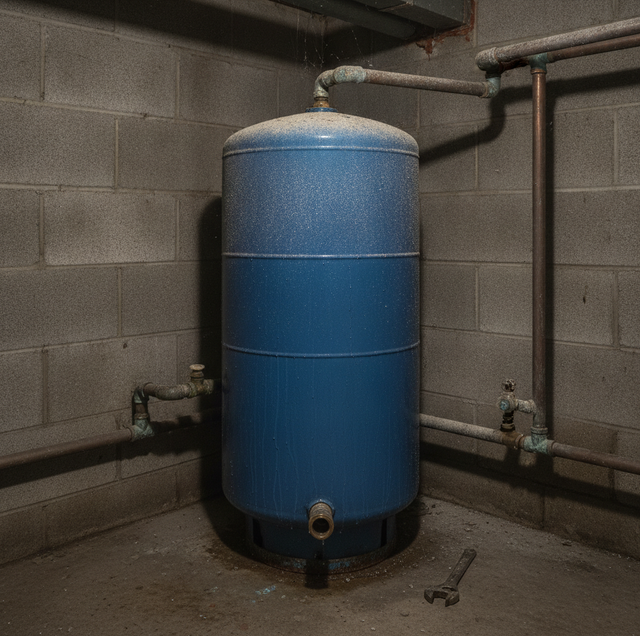
When a well system starts acting up, the pump gets the blame almost every time. The pump is the part people know by name, it costs the most, and it is the thing that makes the noise. So when the water pressure gets jumpy, or the motor seems to run more than it should, the pump is the first thing on the chopping block. Plenty of good pumps get pulled from the well and replaced over a problem they never had.
The pressure tank sitting quietly next to the well is usually the part that failed. It has no moving parts you can hear, so it fails silently, and its symptoms show up as pump behavior. A tank that has lost its air is what makes a healthy pump switch on and off, as if something is wrong with it. Before you spend on a pump, it is worth learning what the tank is supposed to do and how to read the signs that it, and not the pump, is the culprit.
What the Tank Actually Does, and Why the Air Matters
A pressure tank is not just a reservoir of water. It stores water under pressure using a cushion of compressed air, and that air cushion is the whole point. Without it, the pump would have to kick on the instant you opened any tap and shut off the moment you closed it.
Here is the cycle. The pressure switch turns the pump on at a low point (the cut-in, often around 30 or 40 psi) and off at a high point (the cut-out, often around 50 or 60 psi). As the pump fills the tank, it compresses the air cushion. When you open a faucet, that compressed air pushes water out to your fixtures while the pump stays off. The amount of water you get between cut-out and cut-in, before the pump has to run again, is called the drawdown. A healthy tank might hand you several gallons of drawdown on every cycle.
Waterlogging occurs when the air cushion disappears and the tank fills almost entirely with water. Water does not compress, so there is nothing left to push it out and nothing to absorb the pressure swing. Drawdown shrinks from gallons to a cupful. Now the pump has to start and stop constantly to do the job the air used to do. Every symptom below traces back to that one failure: no cushion of compressed air.
The Warning Signs, Read as One Story
These do not usually arrive one at a time. They tend to show up together because they are all the same failure seen from different angles.
The pump runs far more than it used to, or almost constantly: With little or no air cushion, the tank cannot hold a charge of water between cycles. The pump refills the tank, the small pocket of water is used up almost immediately, and the pump fires again. On a badly waterlogged tank, running the kitchen faucet for a minute can start the pump several times.
Rapid cycling, the fast on-off-on-off click: Stand near the pressure switch with a tap open, and you may hear it snapping on and off every few seconds. This short cycling is the single most telling sign and the most damaging. Each start draws a surge of current and heats the motor; starts, not run time, wear out a pump motor and pit the switch contacts.
Sputtering, spitting faucets: When a tank's internal bladder ruptures, air sealed on one side leaks out and is pushed into the water lines. You get spurts, coughs, and air spitting out of the aerator, often worst at the fixture farthest from the tank. Air in the lines on a closed system almost always points back to the tank, not the well.
Pressure that surges and sags: With no cushion to smooth things out, pressure races from cut-in to cut-out and back with nothing in between. In the shower, you feel it as a hard surge followed by a weak dribble, over and over, instead of a steady stream.
A tank that feels heavy and dead: A tank with a proper air charge is light and hollow up top. A waterlogged one is full of water, so it feels heavy, and sweating condensation on the outside is another hint that cold water, not air, is sitting right behind the steel.
A compact way to keep them straight:
| What you notice | What it usually means |
|---|---|
| The pump runs almost every time water is used | Little or no air cushion, drawdown nearly gone |
| Fast on-off-on-off cycling at the switch | Waterlogged tank forcing rapid starts |
| Air spitting or sputtering from faucets | The bladder has ruptured, and air is crossing into the lines |
| Pressure surges then sags in the shower | No cushion to smooth the swing between cut-in and cut-out |
| The tank feels heavy, and it sweats on the outside | Tank filled with water instead of holding an air charge |
Bladder Tank or Older Air-Over-Water? They Fail Differently
Not every pressure tank is built the same, and the type you have changes how it loses its air.
Most tanks installed today are bladder or diaphragm tanks. A sealed rubber bladder keeps the air on one side and the water on the other, so the two never touch. These fail one of two ways: the air slowly permeates out through the valve or the rubber over the years, and the cushion quietly shrinks, or the bladder tears and lets water onto the air side all at once. A slow leak gives you gradually worsening cycling; a rupture can waterlog the tank in a day.
Older systems often use an air-over-water tank, usually a plain galvanized cylinder with no bladder at all. Air and water share the same space. The trouble is that water constantly absorbs the air above it and carries it out to the house, so these tanks go waterlogged much faster and were designed with a small device, an air volume control, or a snifter valve, to keep feeding air back in. When that control clogs or fails, the tank loses its cushion within weeks. If your tank is an older galvanized style and it is short-cycling, a failed air control is a prime suspect before the tank itself.
How to Check It Yourself
You can confirm a waterlogged tank in a few minutes with a tire pressure gauge and your knuckles.
Start with the tap test. Rap your knuckles up the side of the tank from bottom to top. A healthy tank rings hollow near the top, where the air sits, and thuds dull and solid near the bottom, where the water is. On a waterlogged tank, you get the same dull, solid thud all the way up because the water is nearly to the top.
Then check the actual air charge, and this is the step people get wrong. The air pressure in a tank is only meaningful when the system is depressurized. Shut off the power to the pump, then open a faucet or a drain valve and let the water pressure fall to zero. Only now put your gauge on the air valve at the top of the tank, which is a Schrader valve, the same fitting as a bicycle or car tire. Read the pressure.
The correct air charge is about 2 psi below the pump's cut-in pressure. If the switch turns the pump on at 30, the tank should read roughly 28 psi with the system empty; a 40 cut-in wants about 38. Read low, and the cushion has bled off. Read near zero, or worse, get a spray of water out of that air valve instead of air, and the bladder has failed. Water coming out the air side means the tank cannot be recharged and is done.
One caution: temperature nudges the reading, so a tank checked on a hot afternoon reads a little higher than the same tank at dawn. That drift is small. The slow loss of air that waterlogs a tank happens year-round and has nothing to do with the season, so do not wait for a particular time of year to look into it.
What It Comes Down To
The reason this matters is money and motor life. A pump forced to short cycle by a dead tank is being worn out by the very part everyone assumes is fine, and replacing that pump without fixing the tank just puts a new motor on the same treadmill. When the pressure gets jumpy, and the pump seems to run without end, check the tank first. It is the cheaper part, the easier part to test, and far more often than not, the part that actually failed. If the air charge is low but the bladder still holds, the tank may only need air; if water comes out of the valve, it needs replacing. Either way, you will have aimed the fix at the right part instead of the loud one.
Frequently Asked Questions
Once a year is a reasonable habit, and always recheck it right after anyone replaces the pressure switch or the pump, since that work can change the settings the air charge has to match. Check it when the tank is cool rather than after a hot spell for a more honest reading, and do a quick check any time you first notice cycling, before the short cycling has time to cook the motor.
If it is a bladder tank and the bladder is still intact, you can add air at the Schrader valve with a bicycle pump or a small compressor, in short bursts with a gauge, until it sits about 2 psi below cut-in. But if water sprays out of that air valve, the bladder has torn, and residential bladders are not field-replaceable, so the tank has to be swapped. Older air-over-water tanks are recharged by draining them fully to let a fresh pocket of air form, then fixing whatever air control allowed the charge to escape.
The number is not fixed to the tank; it is tied to whatever the pressure switch is set to, so the way to get it right is a rule rather than a figure to memorize: set the precharge about 2 psi below the switch's cut-in, and recompute it any time the cut-in changes. Move a switch up to a higher cut-in, and the tank air has to come up to match the new number, still trailing it by that same 2 psi. That gap is deliberate. Sitting just under cut-in means that at the instant the pump kicks on, the tank still holds a thin layer of water rather than being bone dry, so the bladder is not slammed flat against the bottom of the shell on every start. Skip the reset after a switch change, and you get the classic complaint of a brand-new tank that short-cycles from day one because its precharge is still matched to the old setting, not the one the pump is now working to.
It can, which is why testing beats guessing. A failing switch, a clogged tube feeding the switch, or a leaking check valve down in the well can all mimic a waterlogged tank's rapid cycling. Draining the system and reading the tank's air charge is what separates them: a tank that reads near its target is probably innocent, and the fault is upstream in the switch or a valve.
A quality bladder tank often lasts well past a decade when its air charge is kept correct, while an abused one can fail in a few years. The fastest way to shorten its life is chronic short cycling caused by an incorrect air setting or a tank sized too small for the household, which cycles the bladder far more often than a properly sized tank would. Sizing to the pump's flow and the home's demand is as important as the tank's build quality.
It depends on why the air keeps leaving. On an older air-over-water tank with no bladder, topping up the air or draining the tank to let a fresh pocket form is normal upkeep, since those tanks are built to lose and regain air and usually carry an air-volume control to automate it. A modern bladder tank is a different story. A sound bladder should hold its precharge for years, so if you find yourself pumping air back in every few weeks, the bladder has a pinhole or the air valve is weeping, and each recharge is a stopgap that buys days rather than a repair. You can keep it limping for a short stretch, but a bladder that will not hold is telling you the tank is near its end, and no amount of added air changes that.
Short cycling or air in the lines? Have the tank and pump tested before you replace the wrong part - diagnostic pressure-tank and well-pump service. Pump Repair Services serves Apopka and the surrounding Central Florida area. Call (407) 625-5499.