What Is a Constant-Pressure Well System and Why It Matters
Quick Answer: A constant-pressure well system uses a variable-speed pump paired with an electronic controller that speeds the pump up or slows it down to match how much water the house is calling for at any moment. Because the pump adjusts to demand, water pressure stays close to a single steady setpoint whether one tap is open or several are running. A conventional system, by contrast, runs the pump at one fixed speed and lets pressure swing between a low cut-in and a high cut-out point.
You turn on the shower, someone starts the dishwasher, and the spray goes weak. That drop is not your imagination, and it is not a clogged showerhead. On a conventional well, it is the system working exactly as designed. A constant-pressure well system exists to erase that drop, and the difference comes down to how the pump behaves when demand changes.
Matching Pump Speed to Water Demand
The core idea is worth understanding before any comparison. A variable-speed pump does not run flat out every time it turns on. A controller watches the pressure in the plumbing and continuously trims the pump's speed to keep that pressure at a target value, often something like 60 psi.
When you open one bathroom faucet, the controller runs the pump slowly, just fast enough to hold the setpoint. Open a second fixture and demand jumps, so the controller ramps the motor faster to supply the extra flow without letting pressure sag. Turn everything off, and the pump eases down and stops. The pressure your fixtures see barely moves through all of that, because the pump is doing the adjusting instead of your plumbing absorbing the swing.
A ceiling fan on a dimmer switch behaves the same way. It does not slam between full speed and off. It settles at whatever speed holds the airflow you asked for, quietly changing as conditions change. A variable-speed pump manages water pressure with that same continuous fine-tuning.
How a Conventional Well System Works
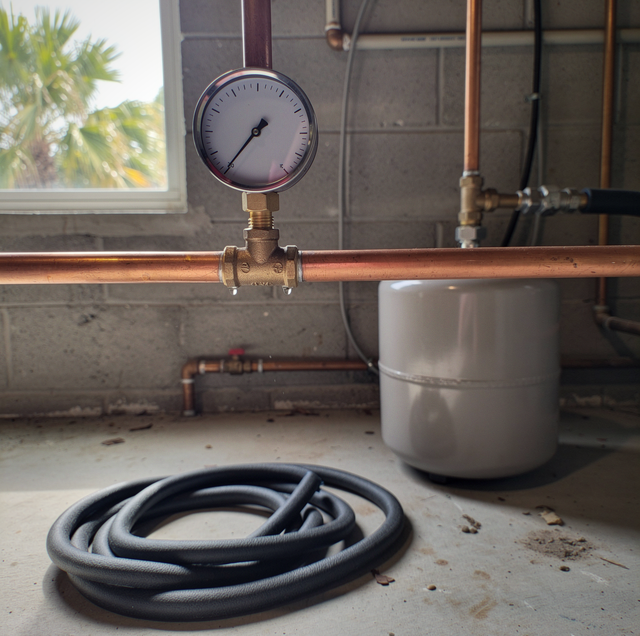
A conventional, or on/off, well system has three main parts: a fixed-speed pump, a pressure switch, and a large pressure tank.
The pump runs at one speed: on. The pressure switch and tank decide when it runs. A common setting is 40/60, meaning the switch closes and starts the pump when tank pressure falls to 40 psi (the cut-in) and opens to stop the pump when pressure climbs to 60 psi (the cut-out). Between those two numbers, the pressure tank stores water under pressure so the pump does not have to start every time you crack a faucet.
The pressure is always moving: Because the system cycles between 40 and 60, the water reaching your fixtures is never at one steady value. Right after the pump shuts off, pressure sits near the high end. As the house draws water, it drifts down toward the cut-in point before the pump kicks back on. You feel that range as a strong-then-weak rhythm, most noticeable in the shower.
Demand exposes the weakness: The bigger complaint shows up when more than one fixture runs. A fixed-speed pump and a finite tank can only deliver so much flow at once. Open a second or third fixture and the shared supply gets split, so pressure at each one falls. The person in the shower loses spray the instant the washing machine fills. The system was sized around one draw at a time, and it shows.
There is a mechanical cost too. Every draw pulls the tank down and eventually triggers another start. Frequent short cycling, the pump snapping on and off in quick succession, is hard on the motor and the pressure switch, and it is a frequent reason older systems wear out or need service.
How a Constant-Pressure System Works
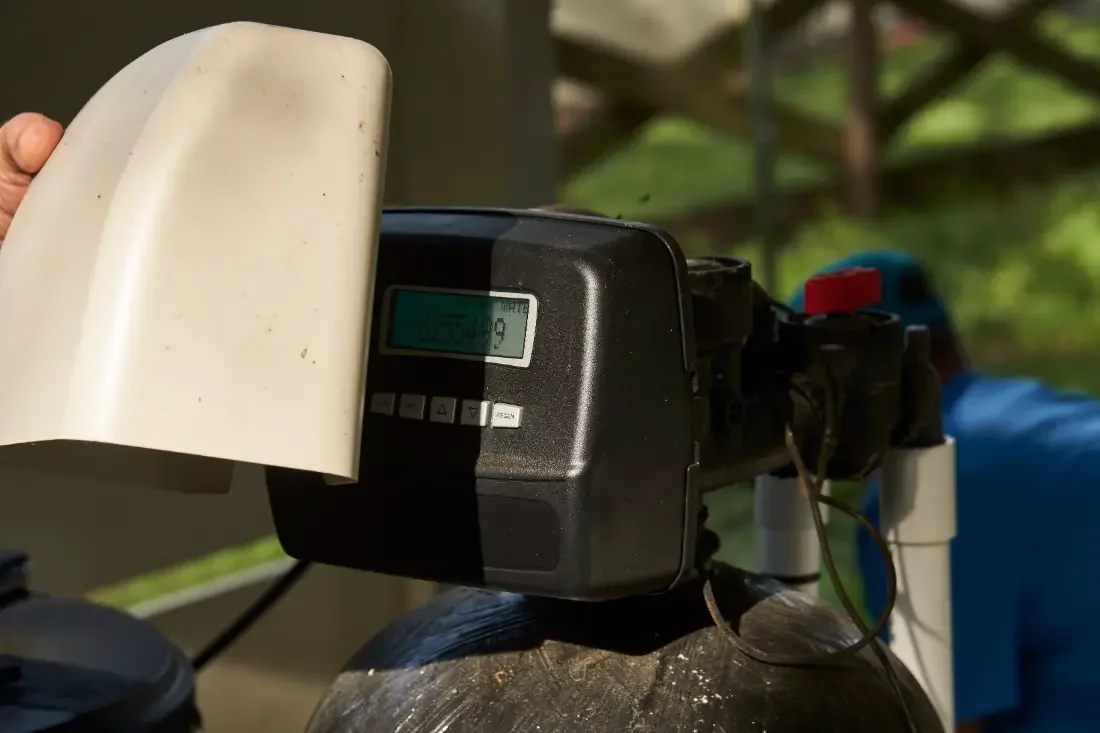
A constant-pressure system swaps the fixed-speed pump and its start/stop logic for a variable-frequency drive (VFD) and a much smaller pressure tank.
The VFD is the electronic controller. It changes the frequency of the electrical power sent to the pump motor, and motor speed follows that frequency. Feeding the motor a higher frequency spins it faster; a lower frequency slows it down. A pressure sensor on the plumbing reports the current reading many times a second, and the drive nudges motor speed up or down to keep that reading pinned to the setpoint.
Why the tank shrinks: On a conventional system, the large tank exists to store enough water to keep pump starts infrequent. A constant-pressure system does not lean on stored water the same way, because the pump simply adjusts its output to whatever is being used. A small tank is still fitted to smooth out the smallest draws and give the sensor a stable cushion to read against, but it does not need to be the tall, heavy tank a conventional setup relies on.
The result at the tap: Open one fixture and the pump loafs along at low speed. Open four, and it works harder, all while the pressure gauge holds nearly flat. That steadiness is the entire point. The plumbing stops swinging between two numbers and instead parks at one.
The Benefits Homeowners Notice First
Steady pressure at every fixture is the headline. Showers hold their spray, and outdoor spigots keep their reach, no matter what else is drawing water.
No pressure drop when several fixtures run is the benefit people feel most. Two showers, a dishwasher, and a filling washer can run together without any one of them going limp. For a house with multiple bathrooms, or one running irrigation zones while people are getting ready inside, that is the difference between a system that copes and one that struggles.
The pump also runs gentler on itself. Ramping up and down puts far less stress on a motor than repeated hard, full-voltage starts. Fewer of those abrupt starts generally means less wear on the parts that fail first on conventional systems. Long supply runs, where friction eats into pressure over distance, also tend to hold up better because the drive can compensate for the loss.
The Tradeoffs Worth Knowing
There is a tradeoff. A variable-speed system is more complex than a conventional pump, switch, and tank, because the VFD and matched pump are more sophisticated equipment with more electronics to set up and eventually service.
There is also more electronics involved. A pressure switch is a simple mechanical part; a drive is a circuit board with sensors and settings. When something in a constant-pressure system needs attention, the diagnosis and repair lean on someone comfortable with the controller, not just the plumbing.
Installation carries more weight, too. A constant-pressure system only delivers on its promise when it is sized correctly for the well and the household and when the pressure setpoint and protection settings are dialed in. An undersized or mis-set system will disappoint, holding a pressure that is too low or failing to keep up with real demand. This is not a place to improvise.
A well pump and its variable-frequency drive are high-voltage electrical equipment. The controller and pump wiring are licensed-professional work, not a DIY project. Any well pump must also be protected against running dry, and that dry-run cutoff needs to be set correctly to guard the motor.
When a Constant-Pressure System Is Worth It
Not every home needs one. A small household on a shallow, generous well with a single bathroom may be perfectly happy on a conventional setup.
The case gets strong when the complaints are about pressure. If water pressure is chronically low, or if it noticeably drops every time a second fixture opens, a constant-pressure system targets that problem directly. Big households with several bathrooms, homes that irrigate while people are inside using water, and properties with long distances between the well and the house all tend to benefit. If a conventional pump is short cycling itself to an early grave, the gentler duty cycle of a variable-speed system can be part of the fix as well.
The honest way to decide is to have the well, the household's peak demand, and the existing equipment evaluated together. The better fit comes down to how much water the home actually draws at once and what the well can supply.
Frequently Asked Questions
Usually, the pump has to change too. A variable-frequency drive is designed to run a matched variable-speed motor across a range of speeds, and most conventional single-speed pumps are not built to run that way for long. Retrofitting typically means installing a compatible pump and drive as a set, plus the pressure sensor. Have the existing motor and wiring assessed before assuming any part carries over.
Many residential constant-pressure systems are set to hold somewhere around 60 to 70 psi, which is why the water feels stronger than a conventional 40/60 system that spends much of its time nearer 40. The exact target is chosen for the home's fixtures and elevation, and a good installer keeps it below the point where it would stress plumbing or fixture valves.
It runs more often but not harder, and that usually nets out in its favor for homes with steady, spread-out water use. Instead of surging to full power for short bursts, the motor spends much of its time at partial speed, where it draws less power. A conventional pump's repeated full-voltage starts each pull a spike of current that a ramped start avoids.
Neither system delivers water without power, because both run electric pumps. A constant-pressure system's small tank holds only a little reserve, noticeably less than a conventional system's large tank, so you get very little water once the power is off. Households that need water during outages usually plan for it separately, with a generator sized to run the pump and drive.
A waterlogged or failed pressure tank on a conventional system often shows up as very rapid pump cycling, the pump snapping on and off every few seconds during a small draw, along with pressure that swings hard. That symptom points to the tank's air charge before the pump itself. It is a common, less costly fix than a pump, and a pro can confirm it by checking the tank's pre-charge and the switch.
They are generally quieter in daily use. A conventional pump announces every start with an audible thunk and a rush as the tank refills. A variable-speed pump ramps up smoothly and often runs at a low hum you may not notice, since it avoids the abrupt full-speed starts. The drive itself is silent; any sound comes from the pump and water movement.
Get your well's pressure evaluated before the next weak-shower morning — a properly sized system holds steady flow at every tap. Pump Repair Services serves Orlando, Winter Park, and Apopka. Call (407) 625-5499.