The logic board makes every decision a garage door opener takes. It reads the wall control, listens for the coded signal from each remote and keypad, watches the safety sensor beam, and switches the motor and the opener light. Line power from the ceiling outlet enters the unit and feeds that board, which then powers the motor and the light on command, so a spike on the household circuit meets the board's electronics on the way in. Motor windings and steel drive parts can withstand a jolt that the board's small, low-voltage components cannot, making the board the first suspect when an opener quits after a power surge. Whether a new board fixes it depends on what else the surge touched and the opener's prior condition.
Each finding after a surge has a corresponding fix.
| What you find after the surge | Fix that fits |
|---|---|
| A matching board is still made for this opener, and the motor and drive ran well before the surge | New logic board |
| Boards and parts for this opener are no longer made | Full opener replacement |
| The wall control, safety sensors, or keypad receiver died along with the board | New board plus the failed accessories, if the opener is otherwise sound |
| The motor or its start capacitor was damaged too | Board plus capacitor; a damaged motor favors a full replacement |
| The opener has no photo-eye safety reversal | Full opener replacement |
Signs of Surge Damage at the Opener
A dead unit: No opener light, no response from the wall control or any remote, and no glow from the sensor lights. With a live outlet and a lifeless opener, the board's power supply section, or the transformer feeding it, is the suspect.
Lights with no response: The opener light comes on, or a status light glows on the housing, but the door ignores every command. Power is reaching the board, and the section that reads commands or the section that switches the motor has quit.
Erratic runs: The door starts on its own, stops partway, or reverses with nothing in its path. A damaged board that still partly runs produces this, and it deserves the least patience, because the door moves when nobody asked it to.
Remotes no longer recognized: The wall control runs the door, but the remotes do nothing. A remote can drop its pairing after an outage with no damage at all, so re-pairing comes first; when re-pairing fails, the receiver section of the board may have taken the brunt of the damage. An opener that hums without moving is a separate fault, with causes from the trolley to the start capacitor.
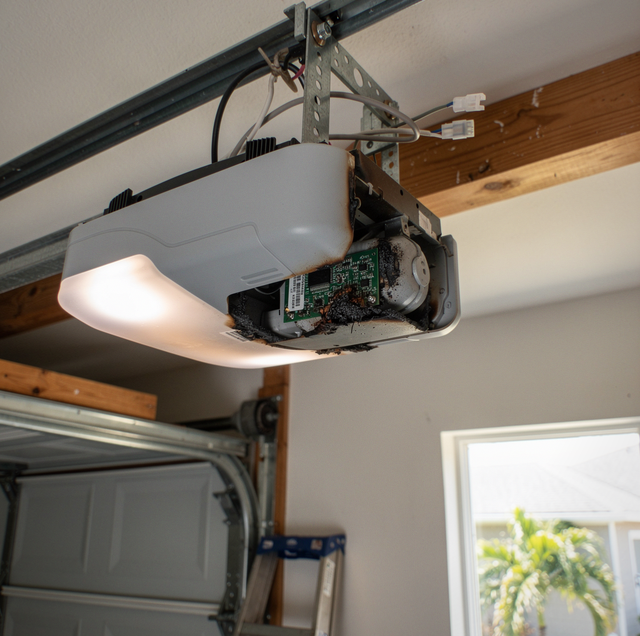
A burning smell or scorch marks: An acrid, hot-plastic smell, or darkened plastic around the powerhead vents, means something inside overheated. That ends the diagnosis: unplug the opener if the plug can be reached safely, and leave it unplugged.
A scorched board can continue arcing or smoldering once power returns, which poses a fire and shock risk in the garage. After any burning smell, the opener stays unplugged, and its housing stays closed until a garage door technician has examined it.
Ruling Out a Tripped Circuit or a Hung Board
Two conditions mimic a fried board, and both can be ruled out without tools if there was no burning smell. The first is power to the ceiling outlet. A breaker or GFCI outlet that tripped during the surge leaves a healthy opener dark, and the giveaway is the garage lights or another outlet on the same circuit going dead with it. A breaker that trips again as soon as it is reset, or a GFCI that will not hold, is a wiring question for an electrician.
The second is a board that survived the spike but was knocked into a stuck state. Unplugging the opener, leaving it unplugged long enough for the board's stored charge to drain, and then plugging it back in forces a clean restart. An opener that comes back to normal operation after that restart had a hung board, and the restart cleared it. One that stays dead or keeps misbehaving has a damaged part or a shorted wire; the next step is to find which one.
What Else on the Circuit a Surge Reaches
Thin low-voltage wires run from the powerhead to the wall control, down the walls to the photo-eye safety sensors near the floor, and in some garages to a separate receiver. Each of those wires connects to the board, and a surge can travel along them just as it travels down the power cord.
The wall control: A dead display, a lock light that will not clear, or a button that does nothing while the remotes still work. A plain push-button control has little inside it to damage, while a control with a display and a lock button carries a small circuit board of its own.
The safety sensors: Sensor lights that stay dark after power is restored, or a door that opens but refuses to close. The sensors run on low voltage from the opener and report back to the board, so a dark pair can mean failed sensors, a damaged sensor wire, or a board that no longer powers its sensor terminals.
The keypad receiver: A wireless keypad on the outside wall runs on its own battery and communicates with the opener by radio, so the part at risk is the receiver that hears it, either on the board or in a separate box wired to the powerhead. On an opener with its network radio built into the logic board, a surge that damages the board takes the app connection down with it.
This sets the order of the repair. A shorted wall-control wire, or a sensor wire whose insulation the surge cooked, can put the same fault onto a new board the moment it is connected, so the wiring and each accessory are checked before a replacement board goes in.
When a New Board Is a Sound Repair
A new logic board makes sense when three conditions line up. The first is availability: boards are made for a specific model and production run, and a board from a different generation of the same model line may not match the wiring harness, the receiver type, or the motor it drives.
The second is everything the board controls. A surge does not age the motor, the drive gear, the rail, or the trolley, so a board swap returns the opener to where it stood the day before the power event, carrying whatever wear it already had. An opener that ran quietly and reliably right up to that day is the strongest candidate.
The third is the door. A new board cannot help a door that is out of balance. With the opener unplugged and the door fully closed, the emergency release frees the door to be raised by hand, and a balanced door lifts with light effort and holds its position partway up. A door that feels heavy or drifts back down has a spring problem that no board can fix: set it down, stop there, and call for spring service, since springs hold stored energy that can injure anyone who handles them.
The swap itself happens inside the powerhead, which means the technician works from start to finish.
When the Opener's Age and Condition Favor Replacement
Years of cycles wear an opener's motor and gear on their own; for a surge-damaged unit, age matters for narrower reasons.
No board to buy: Once a model has been out of production long enough, new boards for it are no longer made. A salvaged board with an uncertain history is a risky choice for the component that controls the safety reversal.
Several failures at once: A surge that took the board, the wall control, a sensor pair, and a receiver leaves the opener needing all-new electronics, which a replacement opener already matches.
A damaged motor: A board and a start capacitor can both be replaced, but if the surge burned the motor's windings, a board repair becomes a rebuild of the whole powerhead.
Missing safety protection: An opener built before photo-eye sensors were standard, or one whose reversal was already sluggish, gets back only what it had if its board is repaired.
Trouble before the surge: An opener that was already due for drive or motor work when the power event hit carries that work forward. A new board fixes only what the surge did, and the older fault is still waiting behind it.
Protecting the Replacement from the Next Surge
Surges arrive from the utility side when equipment on the lines switches or faults, and from inside the house when a large motor or compressor on the same wiring switches off, sending a burst of energy back onto the circuit.
A point-of-use surge protector at the opener outlet plugs into the ceiling outlet, takes the opener's plug, and clamps spikes that arrive on the power cord before they reach the board. It has to be rated for the opener's load, and it diverts the excess to ground, so it depends on a grounded outlet; an outlet without a working ground is a job for an electrician. Some current openers also carry surge protection on the board itself.
A plug-in protector guards only the power cord path, so a spike that comes in along the low-voltage wires to the sensors and the wall control goes around it, and a large enough surge can overwhelm any protector. Protection at the electrical panel and any changes to the garage wiring or the opener's outlet belong to an electrician. What the outlet protector does well is shield a new board from the smaller, repeated spikes a household produces on its own.
Frequently Asked Questions
No. The click is a relay on the board moving its contacts when the board tells it to run the motor. A surge can pit or burn those contacts, so the relay moves and clicks while little or no current reaches the motor. A click with no motion shows the board's command side is alive, and nothing more.
No. The list of paired remotes and keypads is stored on the board, so a new board starts with an empty memory. Every handheld remote, the wireless keypad, and any transmitter built into a car's visor or mirror has to be paired to the new board.
It can. A spike too small to kill a component outright can still weaken it, and a board with a weakened part can keep running, then start acting erratically or fail under the heat of ordinary operation. An opener that turned strange after a known surge belongs in the same conversation as one that died on the spot.
Unplugging it during an outage protects it from the moment power comes back, when the lines can carry a spike as service is restored. It goes back in once power has returned and stayed steady. Opening the door by hand in the meantime means pulling the emergency release, which only occurs with the door fully closed.
No. The part that absorbs a spike in a plug-in protector, a metal-oxide varistor, loses capacity each time it clamps a surge, and after enough of them it stops protecting; on some protectors the outlets keep passing power. Protectors with a protection indicator light show when that point has come, and one whose light has gone out is working only as an extension outlet.
Not through the opener. With the trolley engaged, the opener's drive holds a closed door down, which keeps it from being lifted from the outside. Once the release has been pulled, nothing in the opener holds the door, and anyone can lift a closed door by hand from the driveway. A door with its own slide lock can be locked from inside until the repair is done.
Secure garage door opener repair or replacement — logic board replacement, wall control and safety sensor repair, or a new opener matched to your door. Phoenician Garage Door & Repair serves Phoenix and the Valley. ROC #316471. Call (602) 610-0112.