What Causes a Well Drop Pipe to Leak, and How You Hear It
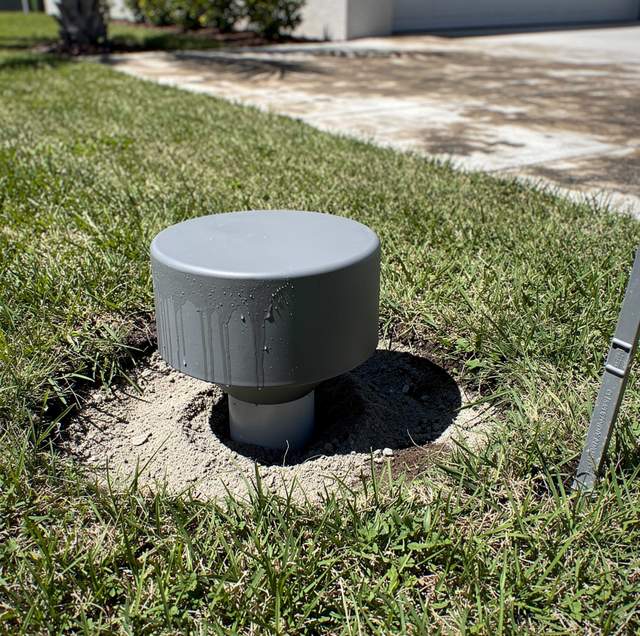
The pump kicks on. Pressure at the tap climbs the way it always has, holds for a second or two, then slides back down while the motor is still running. Out at the well cap, with your ear close to it, you can hear water falling a long way down and landing on water that is already there.
Those three events, in that order, point at the column of pipe hanging between the submersible pump and the surface. Somewhere along it, water the pump has just lifted is going back into the well. The pump is doing its work twice on the same gallon, and your house gets whatever is left over.
What the Drop Pipe Is Holding Up
Between the submersible pump and the fitting where the water turns sideways toward the house runs a continuous pipe run. Two loads move through it in opposite directions.
The weight is heaviest at the top. Every joint carries everything hanging below it, so the topmost joint holds the entire string -- pipe, water, wiring and pump -- while the joint just above the pump holds only the pump. The pressure runs the other way. Inside the pipe, it is highest at the bottom, where the standing column of water above adds to whatever the pump develops, and it falls off as you come up toward the surface.
There is a third load, and it arrives all at once. A submersible motor produces its hardest twist at the instant it starts, and the reaction works on the pipe, which resists it only through its joints.
The column ends at the surface at the pitless adapter, a fitting with its own failure story this article leaves alone. Its length is your pump's setting depth, off your well record, and every foot of it has joints.
Which Joints Give Way First?
Which failure turns up in your well depends on what the column is made of, and the three materials you are likely to find down there come apart in different places.
Galvanized steel pipe is made up on tapered threads. One-inch Schedule 40 has a wall about 0.133 inch thick, an NPT thread cuts roughly 0.070 inch into it, and at the root of the last engaged thread about half the wall is already gone. The zinc went on at the mill, and the thread was cut afterward, through the coating, leaving bare steel where the wall is thinnest and the tension in the string concentrates. Water sits on both sides of it. The pipe body can be perfectly sound while the joint weeps.
Threaded PVC meets the same thread and answers it with wall. NPT dimensions follow the pipe's outside diameter, so that 0.070 inch comes off a plastic wall exactly as it comes off a steel one. Schedule 80 carries 0.179 inches, whereas Schedule 40 carries 0.133 inches, and the thread leaves 0.109 inches standing, which is why drop pipe in PVC is Schedule 80. What PVC will not do is weep first. It is notch-sensitive; the thread root is the notch, and a joint made up too hard splits there instead of sealing.
Poly drop pipe has no threads in it anywhere. Its joints are insert couplings, barbed fittings driven into the bore and held by stainless clamps, and the seal comes entirely from the pipe's own elastic grip on the barb. Polyethylene relaxes under a load it has held for years, so that grip declines, and every start twists the same joint. A clamp set too tight cuts into the pipe wall; one set too loose lets the joint weep from the day it went in.
Your well record names the material that went down the hole. Without it, you find out the day the pump comes up, and the first length clears the casing.
The Sound of a Leak You Cannot See
A drop pipe leak shows up at the tap first, and the pattern is specific. Pressure climbs slower than it used to, and on a bad leak it stalls short of the switch's cut-out setting with the motor still running. Close every fixture in the house and pressure bleeds back down on its own within minutes.
Then there is what you can hear. At the well cap with the pump running, a leak above the water level in the well sounds like a steady trickle a long way down, landing on water.
You will not find anything wet. A leak in the buried line between your well and the house shows itself sooner or later, and its signs arrive in a fixed order: a soft spot in the yard, then a patch that stays green through a dry week, then a meter that creeps with every fixture closed. Each takes longer to appear than the last and settles the question harder. A drop pipe leak leaves nothing at the surface, because the water never leaves the well. It falls down the casing and rejoins the water the pump is drawing from.
When a Joint Parts and the Pump Goes Down
A joint that finally lets go drops everything under it. The pump, the pipe below the break, and the wire go to the bottom of the borehole together, the pipe kinking and folding on the way down. The pump lands in whatever sediment has settled there and can wedge itself sideways in the casing.
Getting it back out is a fishing job. A rig lowers a spear or an overshot on a string of pipe, feels for the top of what fell, engages it and pulls. It works, or it does not, and what nobody can recover obstructs the casing permanently.
The safety rope exists for exactly this. It is polypropylene rope or stainless cable, run alongside the drop pipe and secured at the top of your casing. In normal service it hangs slack and carries nothing. The moment a joint parts, it carries everything below the break, and a pump caught by a rope comes back up on it.
Pulling a column by hand means holding it over an open casing. At 150 feet, one-inch poly carries roughly 100 pounds of pipe, water, and pump, and one-inch galvanized steel passes 300, all of it on the person holding it.
Reading the Legend Printed on the Pipe
Poly drop pipe carries a line of print down one side, repeated every few feet. It gives the nominal size, a pressure rating in psi, the pipe specification it was made to, covering the controlled-inside-diameter polyethylene sold for this job, and a drinking-water certification mark, along with the maker and a lot code. Rigid PVC carries the same kind of line, with one correction: threading the pipe halves the pressure rating printed on its wall.
A pressure rating is worth working out against your own well. A cubic foot of water weighs about 62.4 pounds and rests on 144 square inches, so one foot of standing water puts 0.433 psi on whatever is beneath it. At a 200-foot setting depth, the joint just above your pump carries about 87 psi from the water standing over it before the pump contributes a thing. Add the 60 psi the pump holds at shutoff with a 40/60 switch, and that bottom joint sits near 150 psi whenever the system is full and idle.
The coil lying in the yard never sees any of that. The figure at the bottom of your well is the one the printed rating has to clear.
Frequently Asked Questions
Because a hole in a pressurized pipe behaves as a fixed orifice, and flow through it climbs with the pressure difference across it. Early in a cycle, when system pressure is low, the pipe loses little. and your fixtures are served normally. As the pump works toward its cut-out setting, the loss rises until it matches what the pump is producing, and the gauge stops climbing.
Only when the hole sits above the standing water level in the well. Water leaving the pipe above that level falls through the air and lands on the water surface, producing the trickle you can hear at the cap. A hole below the standing level discharges into water and makes no sound at all, so a quiet cap does not clear your drop pipe of suspicion.
The string comes up either way, and the inspection happens as it clears the casing. Galvanized drop pipe is made up in joints around twenty-one feet long, so counting joints as they come off gives the depth of the fault the moment it is found. Before any of that, a pressure test on the column with the pump's check valve isolated separates a leaking pipe from a leaking valve.
That follows from the pump's flow and the setting depth together. Water moving through pipe loses pressure to friction, and that friction head is added to the lift when the total head the pump works against is figured against its performance curve. A narrow pipe on a long string gives away delivered pressure at your fixtures through its bore alone, which is why a deeper setting can call for a larger size than a shallow one.
That depends on which state the joint is in. A pinhole or a weeping thread is a scheduled job; your well keeps working while you arrange it. A joint that has backed off is a different matter. It holds the load on the few threads still engaged while it leaks past the rest, and nothing at the surface says how many remain. A leak growing louder week to week belongs in that second group.
A torque arrestor does. It clamps onto the drop pipe a short distance above the pump, and its flexible fins bear against the inside of your casing. When the motor kicks the pump one way at startup, the arrestor directs that reaction into the casing wall rather than letting it act on the pipe and its joints. It also holds the pump centered so it stops swinging into the casing and chafing the cable.
A replacement column gets cut to this well's own numbers — the setting depth and static level off your well record, so the pipe, the fittings and the rope are made up to those figures before anything comes out of the casing. Pump Repair Services serves Orlando, Winter Park, and Apopka. Call (407) 625-5499.