What Keeps a Mobile-Home or RV Park’s Community Well Running
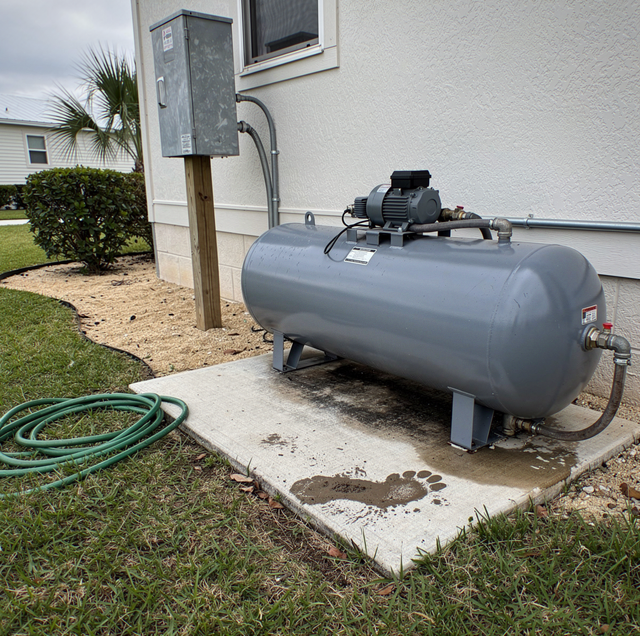
Water in a mobile-home or RV park reaches every lot from one well, one pump, and one bank of pressure tanks sitting somewhere near the back of the property. That arrangement is invisible on a good day and impossible to ignore on a bad one. When three residents call within an hour about pressure fading in the shower, the fault is almost never in three separate homes. It sits upstream, in equipment the park owns and most people living on it have never actually seen. A park manager's job in that moment is narrower than it looks, and the boundary around it is worth knowing well before your own water goes out.
One Well Serves Every Lot, So One Fault Reaches Every Lot
Many parks run on a shared community well that supplies every lot. When that system falters, the whole park feels it at once, and a park owner cannot tell dozens of residents to wait until next week. The hardware your park owns and depends on is the community well, the larger pressure tanks, and the controls that keep every lot supplied.
So the first move on a pressure complaint is counting how many lots have it. One home with weak flow at a single faucet can be a problem inside. Four homes at the four ends of the property losing pressure within the same hour is a supply problem, and the difference determines who you call and how fast you call them.
Where a Property Manager's Walk Around the System Stops
Plenty of useful information lies outside the equipment, and gathering it takes nothing more than a walk. Which of your lots lost pressure, and which did not. What time it started, and whether it has happened before on the same lots. Whether the pump is audible and running without ever shutting off, which is a symptom you can hear from the pump pad without touching anything. Whether pressure comes back overnight and fails again by mid-morning. A technician arriving with that much already established can start on the system in the first minutes.
The line stops at two places, and both of them are hard limits. The control enclosure carries live terminals whenever the park has power, and a fault that trips a breaker does not make the enclosure safe to open. The pressure tanks hold a charge that does not dissipate when the pump is off. Neither one is a place for your maintenance staff, however capable they may be on the rest of the property.
Never open a control enclosure or bleed a charged pressure tank; live terminals and stored pressure injure people, so hand that work to a pump technician.
A Park's Demand Is Not Simply a Larger Household's Demand
Sizing a pressure tank comes down to three standard ways to calculate system demand, and all three are based on a house. The fixture method totals the fixtures in the home, hose bibs included, and multiplies that number by one gallon per minute. The peak demand method counts how many fixtures run simultaneously and multiplies that by 3 gallons per minute. A third method counts bathrooms, with half baths counted as whole ones, and multiplies by four. Use the largest of the three; farms and public or commercial buildings such as schools or motels are sized differently.
A pressure tank does three jobs: it protects the pump from rapid cycling, delivers water between cycles, and stores water when the pump or well cannot supply the system's demand.
On a park, the third function stops being a footnote. Dozens of homes on your property drawing at once can ask for more in a given minute than your pump delivers, and the tank supplies that supplemental drawdown across the stretch, at a pressure between the tank precharge and the pump's cut-in setting. Getting those two right for your property is a technician's job, done with gauges on a running system, and it is why a park's tanks are larger.
Which Warning Signs Point Past One Home to the Shared System?
Signs worth a call before a small fault becomes a property-wide outage include pressure dropping across multiple units, buildings, or zones; a community well pump cycling hard or running constantly; and recurring outages that a patch never seems to solve. The same signs apply not only to a park's own shared well but also to a water feature or fountain pump that keeps failing, and to any well-water business facing downtime it cannot absorb.
For a park manager, the middle item is the one you can verify yourself. A pump that runs constantly, or restarts every few seconds, is working against something in the system it cannot overcome, and every extra hour of that shortens the motor's life while the water gets no better.
The Case for Assessing the Whole System After a Repeat Outage
Recurring outages sit third on that list for a reason worth spelling out. A park's supply carries more parts than a house's: a bigger pump, a community pressure system, several tanks, and demand arriving from many directions at once. Any of those can produce the same complaint at your residents' taps, so a technician who replaces the obvious part is as likely to be treating a symptom as the fault. Commercial work like this means assessing the whole system instead of swapping the obvious part and hoping.
That assessment covers ground a house call never reaches. Commercial work covers large pressure tanks and controls, tested, set, or replaced, and sized for multi-demand systems, which is a different exercise from matching one tank to one household. A park's pressure system has to hold up when a shift change or a holiday weekend puts many of your lots on the water inside the same twenty minutes, and the setting that works at three in the morning may be the setting that struggles at seven, when your whole park showers inside the same hour.
None of that becomes a subscription. Service runs on a per-call basis rather than a subscription contract: when a property needs regular attention, visits are scheduled as they come up, without locking you into an auto-renewing plan. For a park that has been through a run of outages, the thing you book is the assessment, then the repair it points to, in that order.
What to Establish With Whoever Answers the Emergency Call
A park outage is a timed problem, so the terms worth confirming before your next one are dispatch and arrival. The standard commitment is round-the-clock response with a guaranteed two-hour arrival on a water-out emergency, one all-in quote after an on-site diagnosis, licensed and insured work under a five-year workmanship warranty, and over forty years of pump work, plus full-system parts on the truck, the difference between one visit and two.
The division of labor on a shared well is simple enough. A park manager contributes observation and a precise call: which lots, what time, how long, and whether the pump has stopped cycling normally. Everything past the enclosure door and the tank valve belongs to somebody with the training and the meters, and calling early is the part you fully control.
Frequently Asked Questions
Compare lots. One home with weak flow at one fixture and normal flow at the other points to that home. If you open a hose bib at a common point on your distribution line and you find pressure low there too, the problem sits on the supply side.
Whoever runs the property day to day. Coordination happens with whoever runs the property, keeping them informed throughout. Have your lot count ready, the time the first complaint came in, and whether your pump has been running without stopping.
Larger tanks, higher demand, and multiple draw points are part of commercial work, with the pressure system sized and set to the property. The phrase worth hearing from your shop is multiple draw points, because you rarely get that from a house-only outfit.
Dates and durations for every outage, which of your lots reported each one, what part was replaced and when, and the pressure switch settings the last technician left behind. A repeat call with that history in your hands starts from a pattern, and the first hour goes into measuring the whole system.
The precharge is set to 2 psig below the low-pressure cut-in, so your residents do not feel a noticeable drop at the fixture as the tank hands over. It is a setting a technician makes at the tank itself, and never a number you adjust yourself.
Yes, and evaluating a well before you take on a property is worth doing every time. If you are taking on a park, a nursery, or any property that runs on a private well, the well, pump, and pressure system can be evaluated so you know what you are inheriting before it becomes your emergency. An evaluation before closing separates a well already near the end of its service life from a pressure system that was never sized for the lots it now feeds.
Pressure dropping across several lots at once — a park's shared well, its pressure tanks and controls get diagnosed and repaired as one system, by a crew that treats dozens of households as the emergency it is. Pump Repair Services serves Orlando, Winter Park, and Apopka. Call (407) 625-5499.