You reset the breaker, the pump kicks on, and for a second everything sounds normal. Then it trips again before the tank even starts to build pressure. Or it ran for twenty minutes first. Or it only seems to happen the week after a hard rain. None of that is random. A circuit breaker trips for one of two physical reasons: either more current is flowing through it than the circuit is built to carry, or current has found a shorter path to ground than the one it is supposed to take. How long it takes to fire after you reset it tells you which of those two is happening, and roughly where in the pump.
This is a different question from a pump that never shuts off at all; a pump that trips the breaker is being stopped hard at a specific moment, and that moment is the clue.
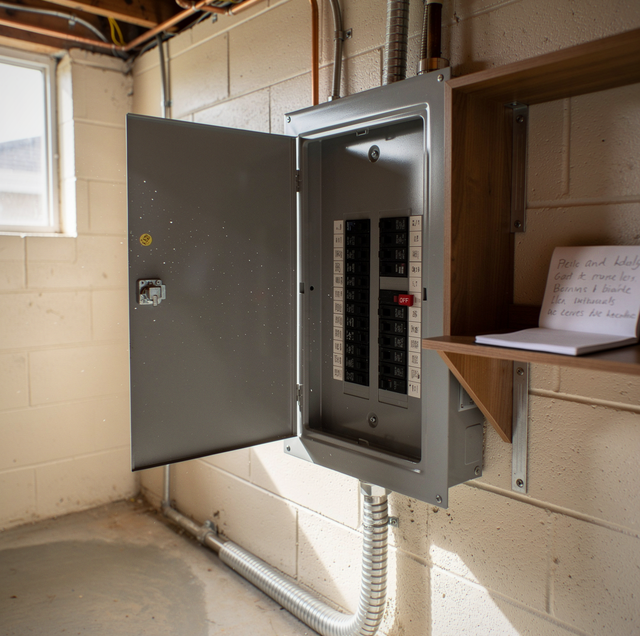
Note the breaker's amp rating from the panel face and the pump's horsepower from your well paperwork before you call. Those two numbers indicate whether the breaker was properly sized for the motor it protects.
A Trip the Instant You Reset the Breaker
If the breaker trips the moment you flip it, before the pump even has a chance to hum, you are looking at a dead short or a grounded winding, not an intermittent fault. A grounded winding means the insulation between the motor's copper windings and its stainless housing has failed completely; the instant current reaches it, the current takes the low-resistance path through the housing and the ground wire instead of through the motor. That surge is thousands of amps, not the pump's normal running draw, and it happens in a fraction of a second, fast enough to fire the breaker's magnetic trip element before its thermal element even registers heat. A wire chafed through its insulation against a metal fitting, or a splice that failed all at once rather than gradually, does the same thing. Nothing about this pattern is intermittent. If the breaker trips instantly on every reset, it will keep doing that no matter how many times you flip it, because the short circuit is still there waiting.
There is one exception. A breaker that is undersized or the wrong type for the load cannot ride the normal inrush current a motor draws at start-up, and it will fire instantly on a pump that is perfectly healthy. That is why breaker sizing gets checked before anyone condemns the motor.
A Trip a Few Seconds Into Every Start
A trip that occurs a few seconds after the motor starts, rather than the instant power reaches it, points to the motor working too hard to get moving, not a dead short. A locked rotor is one common version: sand or mineral scale has bound the impeller against the pump housing, or a bearing has seized, and the motor is trying to turn something that will not turn. A locked motor can draw five to six times its normal running current, and it holds that current steady instead of settling down the way a healthy start does, which is exactly the pattern a breaker's thermal element is built to catch within a few seconds.
The other common cause in this window is electrical rather than mechanical, and which motor you have changes where to look. Three-wire submersible motors and most jet pumps use a start capacitor and start relay in an above-ground control box, and that circuit has to drop out once the motor is up to speed. A two-wire submersible builds its starting device directly into the motor itself, down in the well, so there is no control box above ground to suspect at all. A weak capacitor or a relay that will not drop out keeps the motor running on its start winding longer than it should, drawing high current the whole time. Either way, this is a fault inside the motor circuit that gets diagnosed with the pump disconnected and tested under controlled conditions, not something to chase by resetting the breaker again to see if it starts.
A Trip After Minutes of Running
A breaker that holds through the start and trips only after the pump has been running for a while is telling you the motor got hot, not that it faulted instantly. A submersible pump depends on water moving past the motor housing to carry away heat; anything that cuts the flow past the motor while it keeps running raises its temperature beyond what the thermal element allows. A shutoff valve left partly closed downstream, or a check valve stuck in a way that restricts flow, makes the motor work against resistance it was never sized for.
Short-cycling, the pump kicking on and off in rapid bursts rather than completing a full run, is a diagnosis of its own, but every one of those extra starts pulls the same high inrush current a normal start does, and enough of them close together raises the motor's average heat load the same way one long run would. A well that has drawn down further than the pump was set for is its own repair question, but the way it shows up here is heat: once the water level drops below the pump intake, the motor is moving air part of the time instead of water, and air does not carry heat away from the windings the way water does. All three routes end at the same place, the thermal element, after minutes instead of seconds.
A Trip Only in Wet Weather or Over Weeks
The hardest pattern to read correctly is a trip that shows up only after rain, or that comes and goes over weeks without settling into a clean pattern. This is usually insulation breaking down somewhere in the drop cable or at a splice, letting a small amount of current leak to ground only when moisture reaches the compromised spot. Dry insulation resists that leakage enough to keep the circuit under the breaker's trip threshold; wet insulation does not, so the trip appears with rain and disappears when things dry out, which makes it look exactly like a nuisance breaker rather than a wiring fault.
This is also the pattern most often blamed on the breaker itself, because the breaker resets cleanly, runs for days without incident, and then trips again the next time conditions line up, and a breaker that behaves inconsistently is an easy thing to suspect. The cable and its splices are underground and submerged for their entire working life, so a slow insulation failure can develop for months before it produces a trip anyone notices.
The Breaker and the Pressure Switch Usually Get Blamed First
Two components take the blame more readily than the rest, and neither is usually where the fault actually lives. A breaker can weaken with age and heat cycling, tripping below its rated current, but a weak breaker trips inconsistently across the whole cycle, not at the same point every time. The real test is pattern, not parts: if a trip happens at the same moment in the pump's cycle, instantly, a few seconds in, or after the same number of minutes, on a breaker that is otherwise in good condition, the fault is in the pump circuit, not in the breaker doing its job.
The pressure switch gets blamed next, usually because a short-cycling pump looks like a switch problem from the outside. Worn or pitted switch contacts can force the pump to cycle more often than it should, and every one of those extra starts adds to the heat load described above, but the switch is amplifying a fault more often than it is causing one on its own. Sorting out which component is actually at fault means testing each one under load with the right instruments, which is a service call, not a homeowner project.
One reset, to see whether the trip repeats, is a reasonable check. More than that is not diagnosis; it is repeated stress on a motor that is already telling you something is wrong.
A breaker that trips again is doing its job. Resetting it repeatedly forces stalled-motor current through the windings until the insulation overheats, fails to ground, and a fault becomes a fire risk.
Whether the eventual fix is a single component repair or a full pump replacement is a separate call your technician makes once the actual cause is confirmed. A service call for a tripping breaker starts with the same question: when in the cycle it happens. From there, the motor, the wiring, and the switchgear get tested separately until one of them fails.
Frequently Asked Questions
No, and doing it removes protection the wiring is counting on. A breaker's rating is matched to the ampacity of the drop cable and the motor's full-load amps, not chosen at random. A larger breaker lets a real overcurrent condition continue to flow and heat the wire well past what it is rated to carry, with nothing left to stop it.
Because the compromised part of the cable or splice sits below the well's static water line and stays submerged for as long as the pump is installed. A slow insulation breach does not need rain to reach it directly; it needs the water table around the casing to rise, or the groundwater to shift enough to complete a leak path that was not there before. That is why the delay can run for weeks rather than showing up the first time it rains.
It can. A thermal-magnetic breaker's trip point shifts with the ambient temperature, so a panel mounted somewhere that sits in direct sun or next to another heat source trips at a lower actual motor current than the identical breaker would in a shaded, ventilated spot. That is one more reason a breaker that trips on a hot afternoon and resets cleanly the next cool morning is not automatically a wiring problem.
Yes. The splice where the drop cable meets the motor's own lead wires, sometimes called the pigtail, is potted or heat-shrunk by whoever last pulled the pump, and it is one of the more failure-prone points on the entire wiring run. It sits at the bottom of the well under full water pressure and takes the most handling every time the pump is pulled for service.
Some motor loads are matched to a breaker designed for motor-starting characteristics rather than a general-purpose breaker, because a motor's brief starting current can be several times its running current. Whether your particular setup calls for a specific device is a question for the electrician who services your panel, not something the pattern of trips alone can answer.
Yes, and that is what makes it confusing. A surge reaching the pump's wiring during a nearby strike can weaken the winding or cable insulation without an immediate failure, so the breaker keeps working fine for days or weeks until that weakened spot finally gives out and starts tripping, even with no storm anywhere nearby that day.
Get a tripping well pump diagnosed properly — a technician can trace the fault to the motor, the cable, or the switchgear before it costs you the pump. Pump Repair Services serves Orlando, Winter Park, and Apopka. Call (407) 625-5499.