Draw-Down Correction on a Well: What the Numbers Tell You
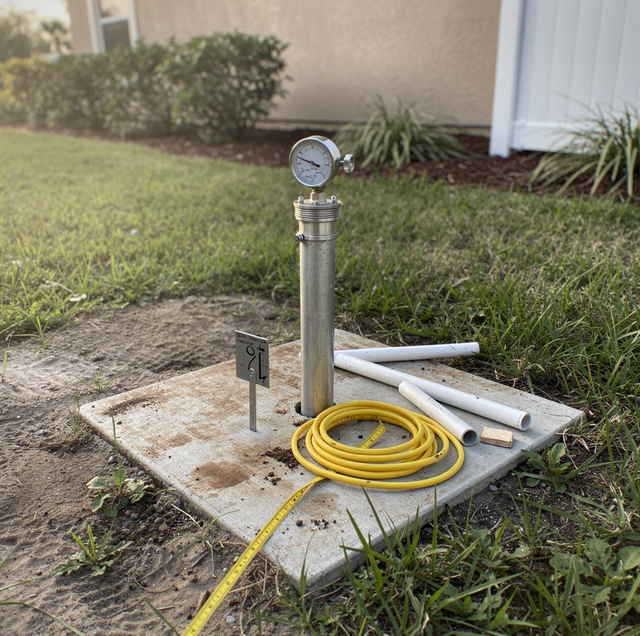
Below your yard, inside the well casing, the water stands at a resting depth. Start the pump and that surface falls, because water leaves the casing faster than the formation around the well pushes it back in. How far it falls, and whether it settles well above the pump or keeps sliding toward it, is what a draw-down measurement captures. A draw-down correction is what happens when the measurement shows the water falling to the pump: the reading is the diagnosis, and the correction is the work that answers it.
Quick Answer: Draw-down is how far your well's water level falls while the pump runs, measured from a fixed reference point. A draw-down correction is the downhole work that follows when that fall reaches the pump intake, usually resetting the pump deeper.
Static Level, Pumping Level, and the Gap Between
A recorded set of levels has a resting position, a running position, and the distance between them, and only the positions are places you could point to inside the casing.
Static water level: With the pump off long enough for the water in the well to settle, the water surface in the casing reaches a specific depth below the reference point. That resting position reflects the pressure in the water-bearing formation around the well, and it is the well's baseline.
Pumping level: Once the pump starts, water leaves the casing faster than the formation can push it back in, and the water level drops. It keeps dropping until it reaches a depth where water enters the well at the same rate the pump removes it, and there it holds for as long as the pump keeps running at that rate.
Drawdown: The distance between those two positions, and the number a technician is really after. It measures the drop in the water surface before the formation can deliver what the pump is asking for.
A pumping level on its own says very little. Read next to the static level from the same well, it measures how hard the formation is working to keep up.
The Measurement, and the Correction It Leads To
A draw-down correction is remediation at the well. What the measurement diagnoses is a pump sitting at a depth the well no longer supports: the pumping level falls to the intake during a long run, or stops just above it with nothing left over. The correction resets the pump deeper in the well, so the intake stays below the level the water falls to while the pump runs. That is downhole work, and it is quoted alongside drop pipe replacement because the string of pipe hanging the pump is what fixes its depth.
Tying the Reading to a Fixed Point
Every depth reading at a well is taken from somewhere. The top of the casing, the top of the sanitary seal, the ground surface at the wellhead: each is a different starting height, and the same water surface read from each produces a different number. The correction applied to the reading itself is the arithmetic that ties it to a stated reference point, so the figure describes where the water sits relative to a fixed, known starting height.
That arithmetic moves no water and replaces no part. What it produces is a number that can be set beside a reading from another visit and compared honestly. The physical correction is what the comparison calls for once the margin above the pump has closed up.
Keep the paperwork from every well visit in one folder. A single set of levels describes one day. The same measurement repeated across several years is what shows whether your well is holding its position.
What a Small, Fast-Recovering Drawdown Tells You
The water surface drops a short distance after the pump starts, settles quickly, and holds through the whole run. Shut the pump off, and the level climbs back toward its resting position within a short stretch. That pattern describes a well where the formation is porous enough, and the screen or open borehole clear enough, to feed water in nearly as fast as the pump takes it out.
For the pump, that means a wide margin of water standing above the intake at every point in the cycle: the motor stays submerged, the intake stays covered, and the flow the pump was built to move stays available. A well with this profile usually absorbs added demand later without the level coming near the intake.
Where a Large or Deepening Drawdown Points
A level that falls a long way before it steadies, one that never quite steadies inside a normal pump run, and one that steadies deeper this year than at the last visit all get flagged.
Each describes water leaving the casing faster than the formation can replace it, and the water arrives from two directions.
One direction is supply. The material around the well may be fine-grained and slow to release water, the producing zone may be thin, or the openings that let water in may be partly blocked. The well cannot deliver at the rate being asked of it, and the level falls until the difference in pressure is enough to force water in faster.
The other direction is demand. A pump sized for a flow rate the well never supported produces the same falling level in an otherwise healthy well. So does a well that ran fine for years until an irrigation system, a pool auto-fill, or a second household went onto the same pump.
A technician separates the two by watching how the level responds when the flow is reduced. A well that steadies at a comfortable position once flow comes down is producing well at a lower rate than the pump is set to move. A level that keeps sliding at any useful flow points at the supply side.
Both directions end in the same place if the level reaches the pump. The intake starts taking air along with water, delivery breaks up, and the motor loses the stream of water that carries its heat away. Pressure symptoms at the fixtures come from other causes and get diagnosed separately; the level in the well is a reading taken at the wellhead.
Pump Setting Depth and the Pumping Level
The pump hangs at a chosen depth on the drop pipe, picked against numbers that were true on the day it was set. That depth fixes the clearance above the pump, the column of water still standing over the intake when the pumping level is at its deepest, and the clearance below it, the distance to the bottom of the borehole where fine sand and sediment settle.
The upper clearance is what keeps a submersible pump doing its job. The motor is cooled by water flowing past the motor housing on its way to the intake. When the pumping level reaches the intake, that flow becomes intermittent, and the motor runs hot until the level covers it again. Repeated through a long run, that heat load takes years off a motor.
Sediment settling at the bottom of a borehole raises the floor beneath the pump. Where a pump already sits close to that floor, a deepening pumping level and a rising sediment bed close the same gap from both ends.
Where that gap has closed up, setting the pump deeper is sometimes possible and sometimes not. It depends on how far the casing and screen go, the condition of the borehole below the current setting, and how much sediment has built up. A well can have plenty of drilled depth and very little usable depth beneath the pump.
Casing condition is evaluated separately, and where casing work is needed, the levels are read again afterward because earlier readings reflect a well in a different shape.
What Moves the Number Between Visits
Recharge: Water enters the formation from the surface, percolating down through soil and rock until it reaches the saturated zone. When plenty of water infiltrates, the level across the formation rises, and the static level in your well rises with it. When little reaches the saturated zone, and withdrawal continues, it falls. Static and pumping levels move together, so the drawdown between them can hold steady while both readings shift.
Nearby demand: Other wells drawing from the same water-bearing zone pull the level down in a cone around themselves, and where a neighboring cone overlaps your well, its pumping shows up in your numbers.
Screen and borehole fouling: Fine sand and silt work into the openings that let water into the well and into the formation just outside them, and mineral scale builds in the same places. With the same pump and the same demand, water has a harder time getting in, so the pumping level settles deeper each year and the drawdown grows. That slow, one-direction drift distinguishes a fouling problem from a dry stretch that reverses once recharge returns.
What the Number Changes About the Job
Pump selection: A replacement pump is chosen for a flow rate the well can sustain, at a head defined by the pumping level. A pump specified from the fixture count alone, with no level data behind it, is how a well ends up with a pump that outruns it.
Setting depth: The distance between the deepest pumping level and the intake is the clearance the setting has to preserve, and it gets checked against what the borehole below allows.
Which side gets the work: A drawdown that grows while the static level stays put moves attention to the well's intake surfaces, where chlorination, screening, or sleeving addresses restricted inflow. A drawdown that shrinks alongside falling delivery moves attention to the pump and the drop pipe.
Whether the well gets watched first: A well that moved for recharge reasons reads differently from one drifting year over year, and telling them apart takes a second set of readings later in the cycle.
How the system holds pressure: Equipment that holds steady pressure across changing demand gets chosen with the level data as one input, because a well with little water standing above the intake has no room to absorb a hard ramp in demand.
Whether a pump is worth repairing: That gets weighed separately, with the levels defining what the well will support from whatever goes back in the hole.
Corrected and written down with its reference point, the number becomes the baseline the next technician measures against, and the margin it describes is what says whether the pump is still set where the well can keep it fed.
Frequently Asked Questions
Because a depth reading starts wherever the measurement started. Casings get cut down, wellhead work changes the height of the access port, and a reading taken through a side opening begins somewhere other than the top of the casing. Without a stated reference point recorded next to each figure, a well can look like it changed when the only thing that changed was where the measuring began.
Because a level caught early in a run is still on its way down, and it describes nothing repeatable. The runtime indicates that the level had stopped moving by the time the reading was taken. The flow rate gets written down alongside it for the same reason: it is part of what produced that depth.
Yes. A new pump moving a different volume per minute pulls the level to a different depth in the same well, so a pumping level recorded under the old pump does not line up against one recorded under the new one.
It applies, with an added ceiling. A pump mounted at the surface lifts water by suction, and practical suction lift tops out around 25 feet regardless of pump size, because atmospheric pressure is what pushes water up the pipe. On a shallow well, the pumping level gets watched against that suction limit too.
That sound usually means the pumping level has dropped below a point where water enters the well, so water is falling freely down the inside of the casing to reach the water standing below. Cascading water also picks up oxygen on the way down, which can speed iron and mineral precipitation onto the casing and screen.
No. Household use is a series of short draws with pauses between them, and the level lifts a little in every pause, so the water surface spends the day inside a narrow band. An irrigation zone is one steady pull at a fixed rate held for a long stretch, and the level settles at the deepest point it reaches all week. A pumping level recorded under household demand alone can miss that depth entirely.
Schedule a drawdown measurement — a technician records your static and pumping levels, ties them to a fixed reference point, and explains what the gap means for your pump and your well. Pump Repair Services serves Orlando, Winter Park, and Apopka. Call (407) 625-5499.