How Deep Should a Water Well Be? Shallow vs Deep Explained
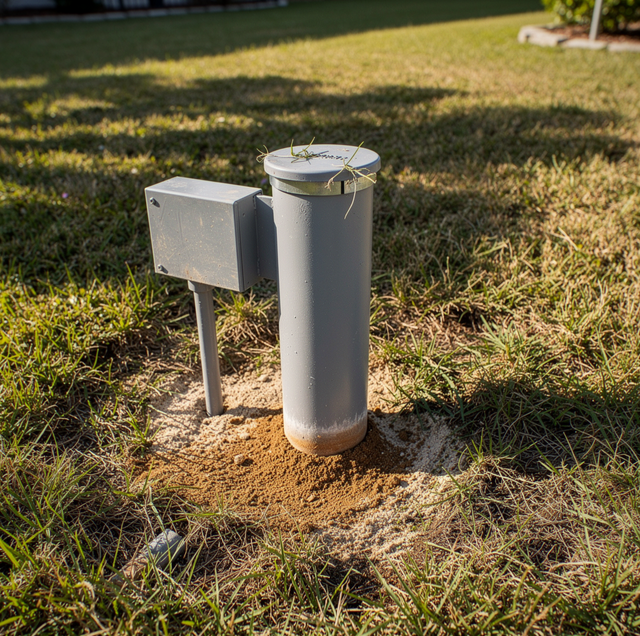
Quick Answer: A well should be deep enough to reach a dependable water-bearing layer that stays saturated year-round, which usually means going past the seasonal high-water mark and into stable aquifer material. Depending on local geology, that can be anywhere from about 25 feet to several hundred feet, set by what is underground, not by a fixed rule.
There is no single correct number of feet for a water well, and anyone who quotes you one before looking at your property is guessing. Well depth is decided by geology, not by preference. You drill down until you reach a water-bearing layer that holds enough water to supply a home reliably, and that layer can sit 25 feet down on one lot and 300 feet down on the lot next door. Understanding why that is true, and what changes as a well gets deeper, helps you read a driller's report and make sense of your own water system.
Water Table and Aquifer Basics
Before depth makes sense, two terms have to be clear. The water table is the level below which the ground is saturated, where every pore and crack in the soil and rock is already full of water. Above it, the ground is damp but not saturated. Below it sits the aquifer, a layer of sand, gravel, or fractured rock porous enough to hold water and give it up to a pump.
The water table is not a fixed line. It rises after wet stretches and falls during dry ones, and it can move several feet across a year. A useful image is the ground as a sponge sitting in a shallow tray: the bottom stays soaked, the top stays dry, and the soaked line drifts up and down as the tray fills or drains. A well has to reach comfortably below that drifting line so it stays in water even when the table drops.
The depth of a well, then, is really a question about how far down the reliable saturated zone begins and how thick and productive the aquifer is once you reach it.
What Determines How Deep a Well Goes
A driller does not pick a depth from a chart. The depth comes from what the drill bit actually passes through.
The local geology sets the target: In one area the first good aquifer might be a shallow sand layer 30 feet down. In another, the shallow ground is tight clay that gives up almost no water, and the driller has to push through it to a deeper sand or limestone layer hundreds of feet below. County well records and neighboring wells give a starting estimate, but the drill confirms the real answer as it goes.
The well has to clear the seasonal low: Reaching water in a wet month is not enough. A well drilled just to the current water table can go dry when that table drops in a dry stretch. A driller sets the depth to stay in water at the seasonal low point, not the high one, which is one reason wells often go deeper than the level where water first appears.
Yield matters as much as depth: Hitting water is only half the goal. The aquifer also has to produce enough gallons per minute to serve the household. If the first water-bearing layer is thin or slow, the driller may continue to a better producer, adding depth to gain a steadier supply.
Shallow Wells
A shallow well typically draws from the first water-bearing zone near the surface, often in the range of roughly 25 to 50 feet, though the exact figure depends on the site. Because the water sits within suction reach, these wells commonly use a jet pump mounted above ground, at the wellhead or in a nearby building, that pulls water up rather than pushing it from below.
Shallow wells cost less to drill and are simpler to service since the pump is accessible at the surface. The trade-off is exposure. Water near the surface responds quickly to weather, so a shallow well is more likely to drop in yield or run low during a drought. It also sits closer to anything happening at ground level, which raises the odds of surface contamination from runoff, septic systems, fertilizer, or spilled chemicals. A shallow well is workable in the right geology, but it asks for more vigilance around the wellhead.
Deep Wells
A deep well reaches a lower aquifer, anywhere from several tens of feet to a few hundred feet down. At those depths, water is beyond the lift of a surface jet pump, so a submersible pump is lowered into the well and sits below the water line, pushing water up the drop pipe from underneath.
The advantages come from that depth. A deeper aquifer is buffered from short-term weather, so supply stays more consistent through dry spells. The water has also passed through far more soil and rock, and it sits well below the reach of most surface pollutants, which generally makes it better protected. The trade-offs are more drilling to reach the aquifer and a pump that lives at the bottom of the well, so servicing it means pulling the pump and drop pipe rather than reaching a unit at the surface.
Why Deeper Often Means Cleaner Water
Depth protects water in two ways. First, filtration. Water works its way down slowly through layers of sand, silt, and rock, and that passage strains out sediment, many bacteria, and a good deal of surface debris before the water reaches a deep aquifer. Second, distance. Most surface threats, such as septic seepage, lawn and farm chemicals, and stormwater runoff, act at or near ground level. A deep aquifer sits far below that zone and is often capped by tighter layers that slow anything trying to migrate down.
This is a tendency, not a guarantee. Depth reduces surface risk, but it does not make water testing optional. Every well, shallow or deep, should be tested for bacteria and nitrates on a regular schedule, since a deep well can still be affected by a poor casing seal or by natural contaminants already present underground.
Why Depth Changes the Pump
The pump choice follows directly from how far down the water sits, and it comes down to a hard physical limit. A jet pump does not lift water by pulling it up a straw indefinitely; it relies on suction, and atmospheric pressure caps how far suction can raise water. In practice, a standard shallow-well jet pump can only draw water up from about 25 feet.
Past that limit, suction alone stops working. Deeper setups solve it in one of two ways. A deep-well jet pump uses a two-pipe configuration and an ejector down in the well to extend its reach. More commonly, a submersible pump is placed below the water and pushes water upward, since pushing from underneath is not bound by the suction limit. If a well is deep and a technician recommends a submersible over a surface pump, that physics is the reason.
Deeper Is Not Automatically Better
It is tempting to assume the deepest well gives the best water, but depth trades one set of concerns for another. As a well reaches deeper into rock, the water spends more time in contact with minerals and can pick up more dissolved iron, manganese, sulfur, or hardness. That is why some deep wells produce very clean but very hard water, or water that carries a sulfur odor, even though it is well protected from the surface.
There is also a difference between quality and quantity. Going deeper can improve how protected the water is, but it does not always increase yield. If the deep layer is dense rock with few fractures, a deeper well can actually produce fewer gallons per minute than a shallower one in a generous sand aquifer. The right depth balances protection, yield, and water chemistry for the specific site rather than chasing feet for their own sake.
Static Level, Drawdown, and the Well Seal
Two measurements describe how a well behaves once it is drilled. The static water level is where the water naturally rests in the well when nothing is pumping. Drawdown is how far that level drops while the pump runs. A well with a high static level and little drawdown is producing comfortably; a well that drains down fast under normal use is near its limit, and the pump must sit below the drawn-down level so it never runs dry and sucks air.
Protection at the top of the well matters just as much as depth. Steel or plastic casing lines the borehole to keep the walls from collapsing and to seal out shallow, unsafe water. Around that casing, a grout seal fills the gap so surface water cannot slip down the outside of the casing into the aquifer. Casing depth and grouting are a core part of keeping a well sanitary, and they are exactly the sort of work that belongs to a licensed driller who sizes, locates, and seals the well to the standards that apply in your area.
Depth requirements, setback distances, and permits vary from place to place and are set by local geology and code, not by a national rule of thumb.
Water down a well combined with electrical wiring is a real shock hazard. Pulling a pump or wiring a well system is professional work, not a weekend project. Siting, drilling, casing, sealing, and any pump or electrical work down the well are licensed and permitted tasks.
Frequently Asked Questions
Your original well completion report, filed with the local permitting office when the well was drilled, lists total depth, casing depth, static water level, and the pump setting. If you cannot find the paperwork, a technician can measure the depth to water with a water-level meter and, in many cases, estimate total depth from the pump wiring and drop pipe when the pump is pulled for service.
Sometimes. An existing borehole can occasionally be drilled deeper if the casing and geology allow, but it is not always possible, since the original casing diameter and condition limit what can be done. When deepening is not feasible, a new borehole is drilled nearby. A driller decides based on the well log and the condition of the existing casing.
Local code sets the exact setback, and it varies by area, but a common minimum is 50 feet between a well and a septic tank and 100 feet from a drain field. Deeper wells with proper casing tolerate closer spacing better than shallow wells, though you should always follow the distance your local health authority requires rather than a general figure.
Somewhat, because the physics is unavoidable: a pump set deeper lifts water a greater vertical distance, which takes more energy per gallon, so a very deep submersible draws a bit more power than a shallow jet pump moving the same volume. In practice, the difference is modest next to the household's overall use, and the steadier supply and better contamination protection of a deep well usually outweigh the extra lift. Right-sizing the pump to the well's actual depth and demand matters more for efficiency than depth alone.
Modern PVC casing can last 50 years or more, while older steel casing typically lasts 30 to 50 years before corrosion, pinholes, or scale become a problem. Casing failure often shows up as sudden sediment, cloudy water, or a drop in yield, and it can often be addressed by sleeving a liner inside the existing casing rather than redrilling.
It can, though it is less likely than with a shallow well. A deep well can lose supply if the regional aquifer is over-pumped, if drought lowers even the deep water table, or if the pump was set too high in the casing. When a previously reliable deep well starts sputtering or pumping air, the pump setting and the aquifer level both need to be checked before assuming the pump itself has failed.
Not sure whether your well or pump is set up right for your property — get a straight answer from a technician who reads the well log first. Pump Repair Services serves Orlando, Winter Park, and Apopka. Call (407) 625-5499.