Iron and hydrogen sulfide are both invisible in well water at the wellhead. The iron rides dissolved in the water as a clear ion, and the sulfide sits dissolved as a gas, and neither one shows itself until something changes that condition: air reaches the iron, and it turns to rust, or pressure drops and the gas breaks free as the smell that gives it away. Splitting those jobs lets each stage do one thing well, which is why a treatment train built for iron and sulfide runs the water through several stages in sequence.
Each stage in that line does one job, catches one thing, and shows its own sign when it starts falling behind:
| Stage | What It Does to the Water | What It Catches | Sign It Is Falling Behind |
|---|---|---|---|
| Sediment stage | Strains out grit and particulate ahead of the reactive stages | Sand, silt, loose scale | Falling pressure at the house, a cartridge caked in grit |
| Aeration | Injects air to oxidize dissolved iron and drive sulfide gas out of solution | Nothing on its own; it converts what the next stage catches | Smell at the cold taps soon after the aeration tank has vented |
| Iron/sulfur media | Filters the oxidized iron particles and remaining sulfide compounds as water passes through the bed | Rust particles the air created, leftover sulfide byproducts | Orange tint at the tap after a backwash, or color creeping back between cycles |
| Carbon | Adsorbs the trace odor that survives the media bed | Residual sulfide compounds and lingering taste | Smell fades right after service and returns before the next one |
| Backwash/regeneration | Flushes trapped material out of a tank so its bed can keep working | Whatever built up in that tank since the last cycle | The cycle runs, but water quality does not improve afterward |
Why Air Comes First
Aeration is the stage that starts the reaction the rest of the train depends on. A pump or an injector introduces air into the water, and that air does two separate jobs at once: it oxidizes dissolved iron, turning it from an invisible ion into a solid rust particle something downstream can filter out, and it drives dissolved hydrogen sulfide gas out of the water and into the air above it, where it has to be carried away rather than left to re-dissolve. The same air carries off dissolved carbon dioxide, which raises the water's pH, and iron rusts more quickly as pH rises. Oxidizing media can finish iron that has started to convert and break down some sulfide on contact, but a bed asked to do all of that work alone loads up and loses capacity; aeration at the front hands it water where the conversion is already underway. That is why aeration sits at the front of the line: it converts the contaminants into a form the rest of the train is built to handle.
Hydrogen sulfide released during aeration is a toxic gas that can collect in a closed room, so the vent runs outdoors, never into a utility room, crawlspace or closet; a rotten-egg smell near the tanks is a job for the installer.
The Media Bed That Catches the Rust the Air Made
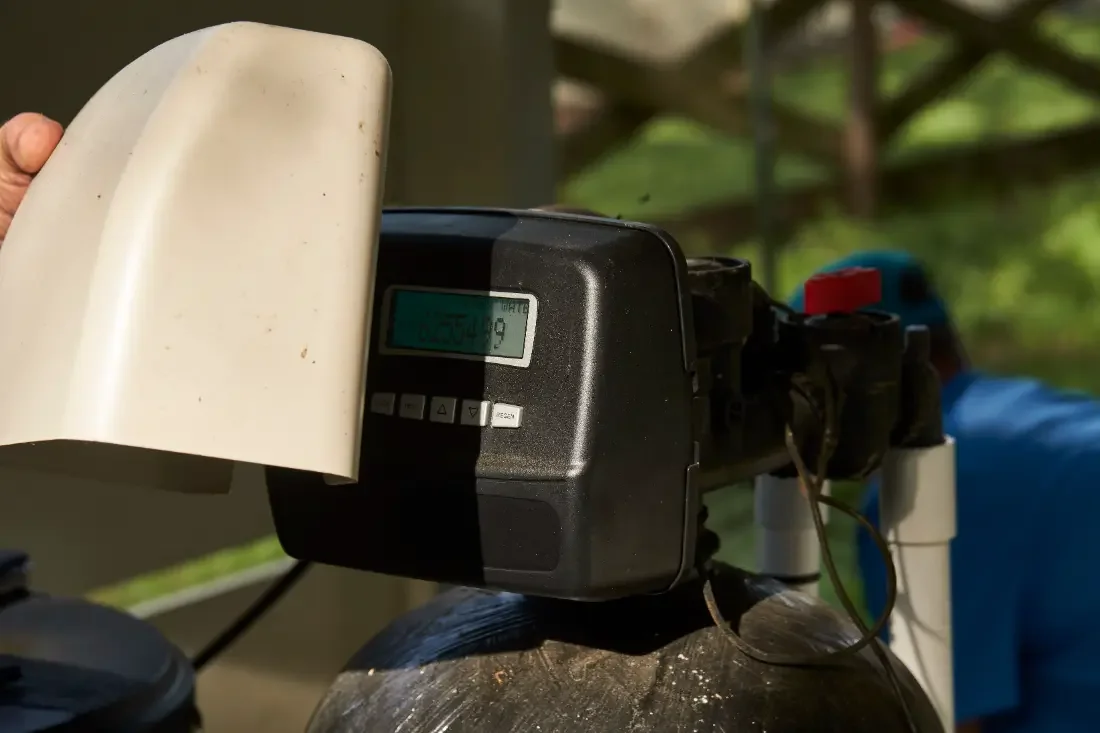
Once the air has done its work, the water still carries solid rust particles and whatever sulfide byproducts did not vent off. The iron/sulfur media bed is where that gets pulled out. Dissolved iron is ferrous iron; the oxidized form, ferric iron, does not dissolve and is the orange-brown solid the bed traps. Water passes through a bed of oxidizing media, and as it does, any iron that has oxidized slowly is finished off at the media's surface, while the solid particles already formed are physically trapped between the media grains. This stage also handles the sulfide compounds that carry through past aeration, breaking them down on contact with the media rather than letting them pass to the next tank. The bed only works while it stays clean, which is why it periodically backwashes: water runs backward through the tank hard enough to lift and rinse the trapped material out to a drain, resetting the bed's surface for the next cycle.
Carbon for the Odor That Is Left
Aeration and the media bed act on iron and sulfide first, but a trace of odor can still get through both stages, and that is carbon's job. Carbon media adsorbs the compounds responsible for the lingering rotten-egg smell, pulling them onto the carbon surface rather than letting them reach the tap. Carbon sits at the end of the reactive stages because its job is to clean up what aeration and the media bed leave behind.
The Sediment Stage Ahead of It All
Everything described so far assumes that the water reaching the aeration tank is already free of sand, silt, and loose scale, and that the sediment stage is for that. It sits ahead of the reactive stages and strains out particulate before it reaches the air injector or the media bed. Grit left in the water can foul an injector, coat the surface of the media, and reduce how much of the bed is doing oxidizing work, so the sediment stage's job is to protect the equipment that does that work. Losing this stage leaves the iron and sulfide levels where they were, but it reduces how well each subsequent stage performs.
Matching the Train to What the Water Test Shows
None of these stages gets sized by guesswork. A water test measures how much dissolved iron and how much sulfide the well produces, and those numbers are what a technician uses to size the aeration tank, the media bed, and the carbon stage for that particular well, rather than installing a generic setup. Wells differ in what they carry, and the equipment gets matched to what that well's own numbers show rather than treated as a package deal. Retesting matters too, because a well's iron and sulfide levels are not fixed for life; a train sized to a test from an earlier point in the well's history can end up undersized or oversized for what the well delivers today.
A sample for sizing is drawn as raw well water, ahead of any filter or softener already in the line, since water that has passed through older equipment can read lower than what the new train will face.
What Upkeep a System Like This Asks For
Each tank in the train runs its own backwash or regeneration cycle on a schedule set when the system is installed, and that schedule keeps the media working rather than gradually fouling. Periodic testing is the second part of upkeep, confirming that the train is still keeping pace with what the well is producing, rather than waiting for a smell or a stain to announce that it is not. None of these stages disinfects for bacteria, so a well that also tests positive for bacteria requires shock chlorination as a separate step handled by the well technician; the homeowner does not dose chlorine into the well. A sudden change in taste, smell, or color in water that has been running clean means stop drinking the water and call for a test.
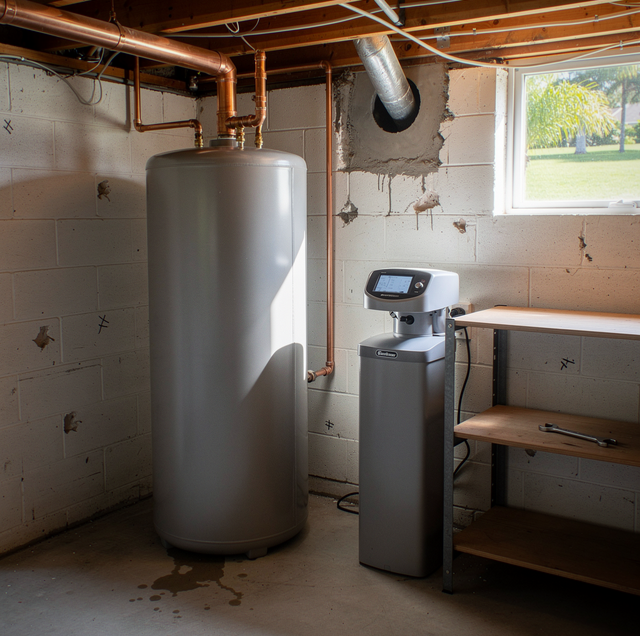
A water softener, when the well's water is also hard, works after this train rather than as part of it, trading dissolved calcium and magnesium out of water that has already had its iron and sulfide handled.
Frequently Asked Questions
The injected air, along with the gas it strips from the water, collects in a pocket at the top of the aeration tank. The vent valve lets that pocket off. If the valve sticks shut, the pocket can grow until air is pushed on toward the house, and air spitting from the faucets is one sign of it, alongside causes in the pump or the well.
Yes. The backwash flow comes from the well pump, and each backwashing tank needs a set flow rate to lift and loosen its bed. A pump that cannot deliver that rate leaves part of the bed packed with what it has caught, so the tank size has to fit the amount the pump can supply.
Backwashing clears trapped particles from the bed, but the media itself has a finite working life, and its capacity to oxidize and capture iron fades as it ages. Eventually the bed needs fresh media rather than another backwash cycle.
Hydrogen sulfide reacts with silver, copper, and brass on contact, so a dark tarnish on silverware or brass fittings can build up alongside the smell and stays after the smell is treated until the metal is cleaned.
No. Iron and sulfide are sized separately, since the two can arrive at different levels in the same well, so two wells with the same iron reading can end up with different aeration and media sizes.
Not always. Some installations combine the iron/sulfur media and the carbon into a single tank with layered media, while others keep each stage in its own tank. Which setup gets used depends on the water test results and how much space is available for the equipment.
Order iron and sulfide removal sized to your water test — sediment, aeration, media, and carbon stages for the iron and sulfide your well carries. Pump Repair Services serves Orlando, Winter Park, and Apopka. Call (407) 625-5499.