This is one of the better-documented groundwater stories in Central Florida, and the documentation is the County's own. In 2013, under EPA-mandated sampling, Seminole County identified 1,4-dioxane at three of its water treatment plants. The Heathrow plant returned the highest result of the three.
The figure from that round, at the Heathrow point of entry on August 1, 2013, was 0.58434 parts per billion. The health advisory level is 0.35 parts per billion. Monroe returned 0.17089, and Markham returned 0.30052 on the same date. Heathrow was the only one of the three above the advisory level in that table, and it was above it by two-thirds.
The same table carries a second round, and it is only fair to read both. On February 12, 2014, six months later, Heathrow returned a reading of 0.1 parts per billion, the lowest of the three at that time, with Monroe at 0.29 and Markham at 0.23. All three were under the advisory level on that date. The 2013 figure was a spike in the series, and anyone quoting it to you without the second row is quoting half the table.
The County then did two things that deserve credit. It made operational adjustments in 2016 to reduce concentrations and reports that County drinking water has tested below the health advisory level since then. It also kept publishing, well by well. Results for the wells identified as HEA-2, HEA-5 and HEA-6 appear in the County's briefing material alongside the Markham point of entry, quarterly, for years. Read that as a utility choosing transparency over silence.
Separately, and predating all of this, the County had already planned to decommission two of the plants, Heathrow and Monroe, with the third redeveloped into a regional facility, Markham Regional. The former Heathrow plant no longer appears in the County's current plant list.
Now the current picture, and it pays to read the whole sheet. In the County's published testing data through December 2025, two of five plants detect it in most months. Markham Regional runs between about 0.11 and 0.23 parts per billion across that stretch, with one non-detect in September 2023, and ends at 0.20 in December 2025. Indian Hills has detected it in almost every month since March 2024, ranging from about 0.07 to 0.12. Of the other three, Lynwood has not detected it in any month the sheet reports a result; Southeast Regional shows two isolated detections, 0.127 in May 2023 and 0.0416 in July 2025; Country Club shows one, 0.0418 in September 2024. That Southeast Regional figure of 0.127 is higher than any Indian Hills result on the sheet, and the County leads with it in its own material.
Two marks on that sheet need explaining, because they are easy to misread. Months shown as quarterly are a sampling schedule and not a result. Asterisks mark something else entirely: contaminated samples resulting from laboratory quality-control errors. The County says on the sheet that the frequency of contaminated samples led it to replace its contracted laboratory in April 2024. Keep that in mind when you get your own result back, because a number on a certificate is only as good as the laboratory that produced it, and a county utility got that wrong often enough to change suppliers.
Two things follow from that, and the second one comes with a caveat we will state before you find it. Every published figure in the finished-water series is below the 0.35 advisory level, with the highest running around 0.2, so the County's statement that testing has been below the advisory level since 2016 holds up against its own finished-water data.
The second is that this is not confined to one corner of the county. Indian Hills returned a non-detect in every month it produced a valid result up to February 2024, then read 0.11 in March 2024, and has been detected in almost every month since. The County replaced its laboratory the month after that, so the two events sit close together on the sheet, and it is worth saying that the change of laboratory does not explain the change in results: that first detection was close to three times the detection level in force before it, and the reporting limit was loosened rather than tightened for most of the period that followed. Two plants on opposite sides of the county are detecting, which is an argument for testing a private well anywhere in it, including here.
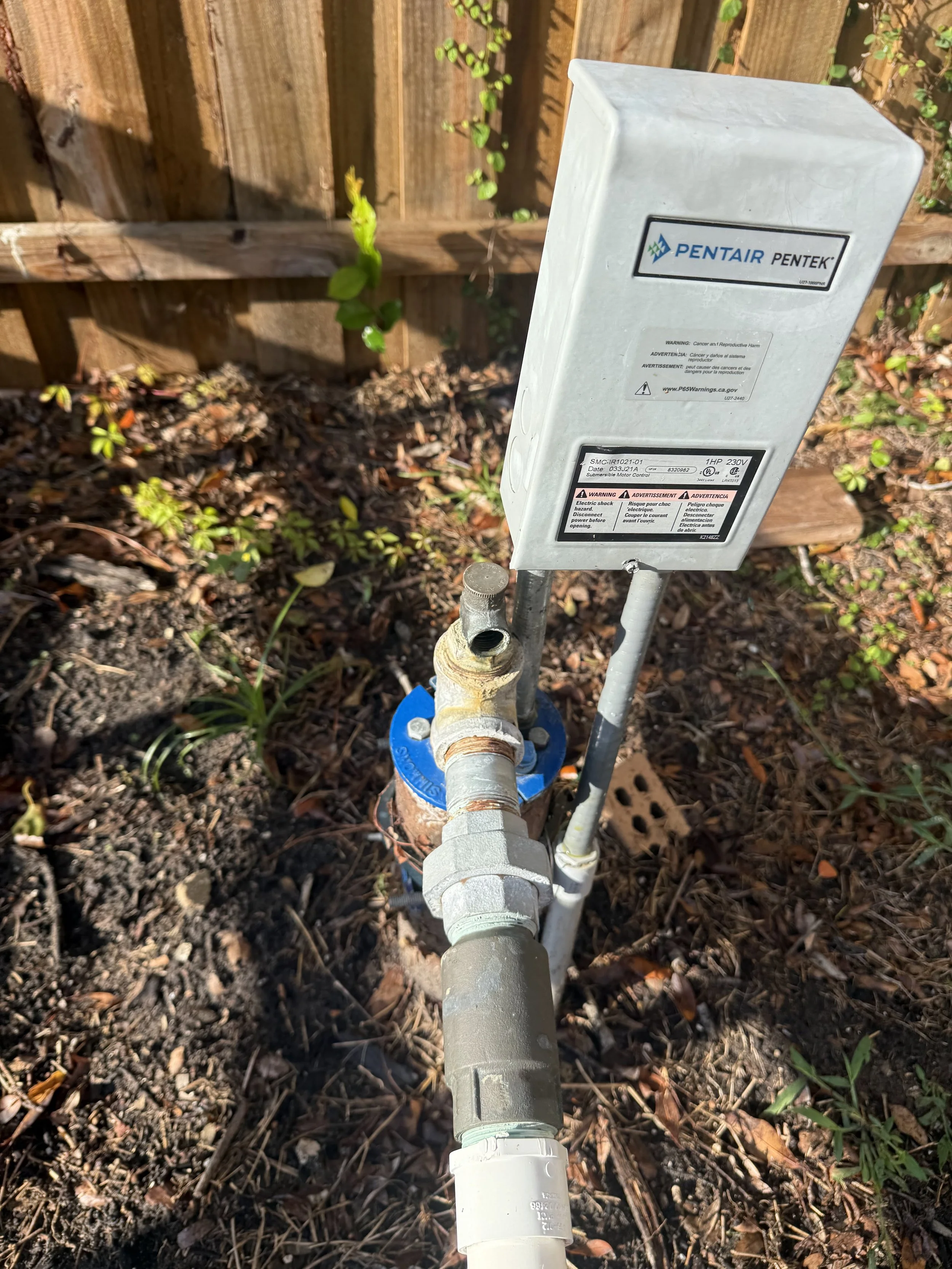
Which brings it to your well, and to who this page is actually for. Heathrow proper is within the Seminole County utility service area, so most addresses with a Heathrow postal code receive County water. The private wells are on the surrounding unincorporated ground, on the older and larger parcels, and on the properties that kept a well for irrigation. If your address takes County water, the County is testing, publishing, and adjusting, and you can read the results yourself. If your address is on a private well, nobody is doing any of that on your behalf. There is no maximum contaminant level for this compound, only an advisory level, so no rule requires a private well to be tested for it and no rule requires anything to be done if it is found. The County has published a private-well dataset of its own, and it is the most relevant thing on this page for anybody on a well. Most results in it are non-detect, but roughly a third are detections. One, sampled in November 2018, read 0.46, above the 0.35 health advisory level. It is the only private well in the County's dataset above that line, and the only figure on this page above it other than the 2013 plant result at the top. The County publishes no locations with that dataset, so none of it can be tied to any particular address, including yours. The County does publish an address-level lookup for its own results, which is the first place to go if you want to see what has been found near you.
That is the whole argument for treating Heathrow differently from the next community over. The groundwater history here is specific, it is published, and the protection that covers a utility customer does not extend to a private well. A well owner who wants to know has to go and find out.