One grain of sand passing through a submersible pump does no harm you could measure. A steady stream of them, carried through the pump every minute the well runs, wears it from the inside. Sand doesn't fail a pump the way a failed capacitor or a tripped breaker does, in one event you can point to. It works on the tight running fits inside the pump a little at a time, and the damage appears as a gradual decline before anyone calls it a sand problem. Grit at the tap tells you sand is present; it says nothing about what that sand has already done on its way there.
Following one grain from the ground to the fixtures shows why sand is a mechanical problem first and a water-quality complaint second.
How Sand Enters a Well
Water enters a well through one of two types of openings, depending on the ground it was drilled into. In sand and gravel, the lower end of the casing carries a well screen, a slotted or perforated section whose openings a driller sizes against the grain size of the formation, so water passes and the surrounding sand stays outside. In rock, a well can be finished with no screen at all: the casing is seated into the rock, the borehole below it stays open on its own, and the casing wall and its seat are what hold back the loose sand lying above the rock.
Either kind of well undergoes development after drilling, when the crew surges or overpumps it to draw the loosest fines from the ground near the openings. In a screened well, that leaves coarser grains packed around the screen; in an open borehole, it clears loose material off the rock face. A well developed properly settles to clear water once development is finished. An under-developed well keeps giving up sand from the material that was never cleared.
Openings also change with age. On a screen, scale or iron-bacteria growth that later breaks loose can leave gaps behind it. In a rock well, a casing crack or a seal at its seat that fails lets sand from above the rock fall into the borehole. A barrier that held on the day the well was finished has to remain in place for as long as the well is in service.
Pump Depth and Pumping Rate Decide What Reaches the Intake
A sound entry point still doesn't guarantee clean water at the pump because the pump's position and the rate it draws both shape what reaches the intake. Fine sediment that enters a well sinks and collects at the bottom of the borehole, below the depth at which a pump is meant to draw. A pump hung close to that bed draws water across settled grit and lifts some of it straight into its stages.
Pumping rate matters at the openings themselves. The speed at which water crosses a screen slot or a rock face is one of the figures a well is designed around, and water entering at high velocity can carry grains that the same opening holds back at low velocity. A pump rated above the flow the well was built to deliver, such as a replacement chosen by horsepower instead of by the well's yield, pulls water through those openings at a speed they were never sized for.
What Sand Does Inside a Submersible
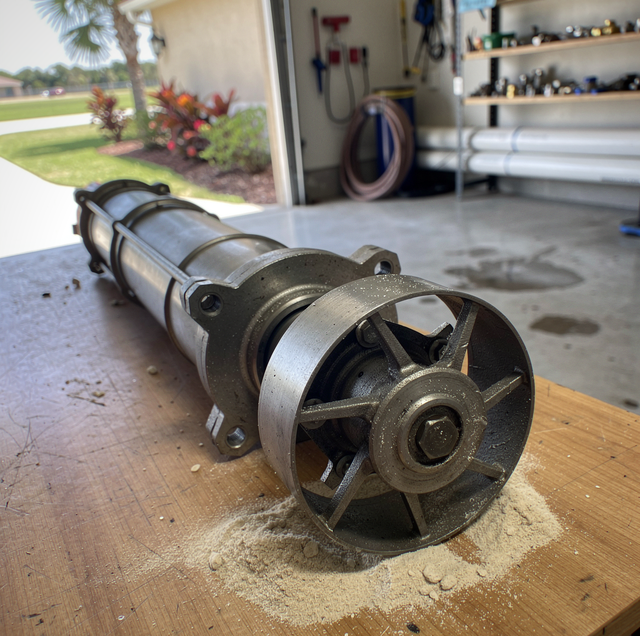
The pump end of a submersible is a column of stages. In each one, an impeller turns inside a fixed diffuser that catches the water leaving the impeller and turns it up into the stage above. The running clearance between the turning and fixed parts is kept tight, since that close fit is what lets each stage hold the pressure it adds. Grit carried through the clearance cuts at both faces, and every pass removes a little material and opens the fit a little further.
Once the fit has opened, part of the water from each stage that has pressurized leaks back to that stage's inlet and is pumped a second time. The pump then delivers less at the same speed, so it runs longer to fill the tank, and those extra run hours are hours the motor would not otherwise have spent.
The motor below the pump end is filled with water or oil and sealed at the factory. Grit that keeps working along the shaft can reach the shaft seal and the sand slinger that keep grit out of the motor, and once grit gets past them, the motor's bearings wear from the inside.
Where the Damage Continues After the Pump
Sand that clears the discharge keeps moving. The check valve just above the pump is meant to close the instant the pump stops and hold the full column of water in the drop pipe. A grain caught on the valve seat props it open, the column drains back into the well between cycles, and each start has to lift that column again before any water reaches the tank.
Beyond the check valve, grit rides on into the tank and its pressure switch, then into the house plumbing, where fixtures with moving parts and fine screens take the last of it. That is the point where it finally becomes visible.
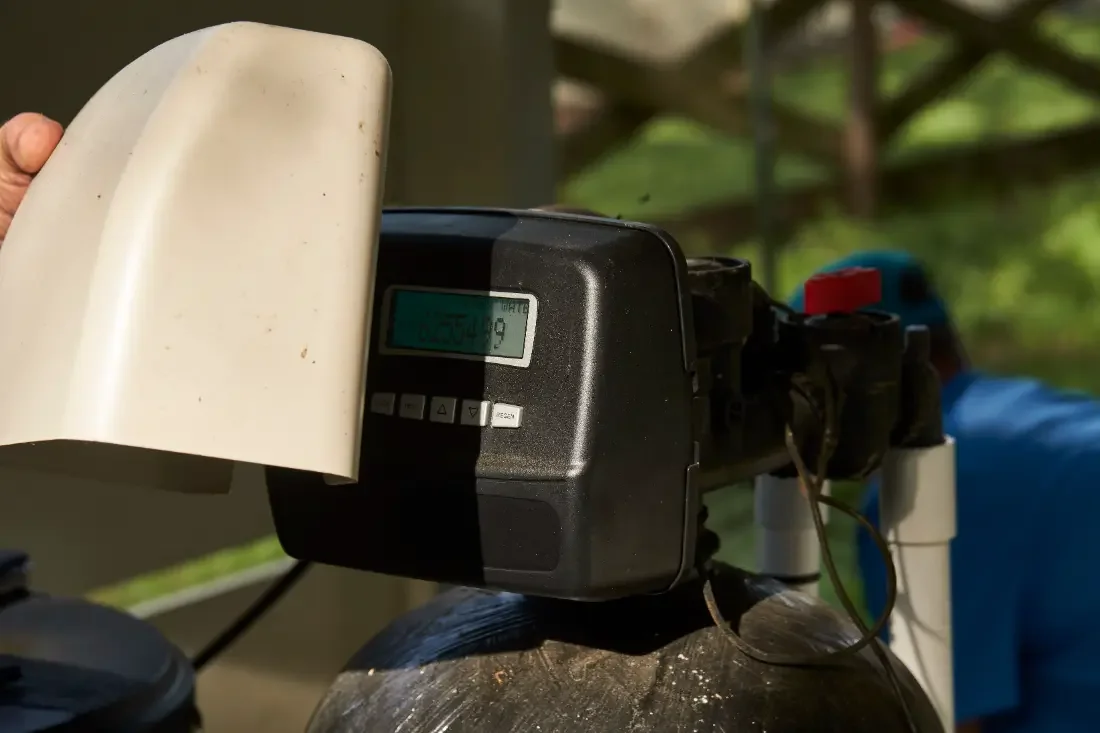
A sand separator ahead of the pressure tank uses centrifugal force to spin sand grains out of the flow. It is sized to the pump's rated flow rate, not the pipe diameter, and fine silt that stays suspended passes through it.
Signs a Homeowner Can Catch
Because the wear is gradual, no single moment announces it. Pressure that once held steady drifts down a little at a time, and the drop shows when two fixtures draw at once. The pump runs a little longer each time it comes on, which you can time by timing how long the tank gauge takes to rise from cut-in pressure to cut-out with every tap closed. Grit collects in faucet aerator screens or as a layer of sand at the bottom of a toilet tank. A faint rumble or vibration at the wellhead that was never there before belongs on the same list. None of these proves the stages are worn on their own; together, they describe a pump delivering less with each hour it runs.
How a Technician Decides What to Fix
The right fix depends on where the sand is coming from. Where the grit is settled material at the bottom of the borehole, the pump's setting is what changes, so the intake no longer hangs over the bed.
Where the formation itself carries heavy sand, a sound screen or rock face still passes some, and cartridge filters in the house load with grit even when nothing in the well has failed. There the lasting answer is the pump's setting and a separator ahead of the pressure tank, where one fits the system, because the sand keeps coming for as long as the well draws from that ground. Where the formation holds little sand, grit at the tap and a filter that keeps loading point somewhere else: at an entry that has opened up, or at a pump hung too deep. That is when the fix moves to the well, where sleeving sets a sound liner inside a failed casing and can carry a new screen section with it.
Pulling the pump shows how far the wear has gone, which determines the next step.
A submersible pump and its drop cable are heavy and wired to line voltage at the wellhead. Pulling one takes a hoist and a licensed technician who locks out the power first, so leave the wellhead closed.
Frequently Asked Questions
Yes. Maximum sand content, by weight, is part of the pump's rating, and 50 parts per million is a common limit on many models. Water above the rated figure is outside the range the stage clearances were designed to handle.
Yes. Makers' installation instructions call for developing the well with a separate test pump before the submersible is installed, so that the sand and fines loosened during development pass through that equipment rather than through the new pump's stages.
The switch reads system pressure through a small tube or pipe nipple, and grit packing at that opening can make the switch misread pressure, so the pump can run past its cut-out setting or chatter on and off. A technician clears or replaces the tube or nipple.
Yes. Some designs use a floating impeller stack, where each impeller can shift along the shaft rather than being fixed in place, paired with diffusers made of abrasion-resistant plastic. Makers sell these as sand-handling designs, and the pump's published sand limit still applies.
A sand content test does this without pulling anything. A technician collects water from an outdoor spigot over a measured period and runs it through a centrifugal cone or a settling tube to measure sediment in parts per million or as a settled volume, which gives a number to compare against a pump's rated limit instead of judging severity by eye.
Yes. The sand it spins out collects in a chamber at the bottom, and that chamber has a purge valve that has to be opened on a schedule to flush the collected sand to a drain; an automatic purge valve can do it on a timer. A chamber that is never purged fills with sand.
Sand already working through your well pump's stages? — Get the pump, check valve, and pressure system checked for sand wear before it turns into a failed pump. Pump Repair Services serves Orlando, Winter Park, and Apopka. Call (407) 625-5499.