Submersible vs Centrifugal: Which Pump Does Your Well Use?
Quick Answer: The main difference is location and depth. A submersible pump sits down inside the well, underwater, and pushes water up — it's used for deeper wells and is quiet and efficient. A centrifugal or jet pump sits above ground (often in a well house or basement) and pulls water up by suction — it's used for shallower wells. The quick tell: if you have a pump unit you can see and hear above ground near the well, it's likely a jet/centrifugal pump; if the only equipment above ground is the pressure tank and there's nothing visibly pumping, the pump is probably submersible, down in the well.
When something goes wrong with your well, one of the first useful things to know is what kind of pump you have — because submersible and centrifugal pumps work in fundamentally different ways, fail differently, and get serviced differently. Many homeowners have no idea which type sits on their property, and that's understandable: one of them is completely out of sight. Sorting out the difference helps you understand your system and have a smarter conversation when you need service.
Two Different Approaches to Moving Water
All well pumps do the same job — move water from underground into your home under pressure — but they take opposite approaches. One type goes down to the water and pushes it up. The other stays up top and pulls the water to it. That single distinction drives almost everything else: where the pump lives, how deep a well it can serve, how it's accessed for repair, and how it tends to fail. Knowing which approach your well uses tells you a lot about what to expect.
How a Submersible Pump Works
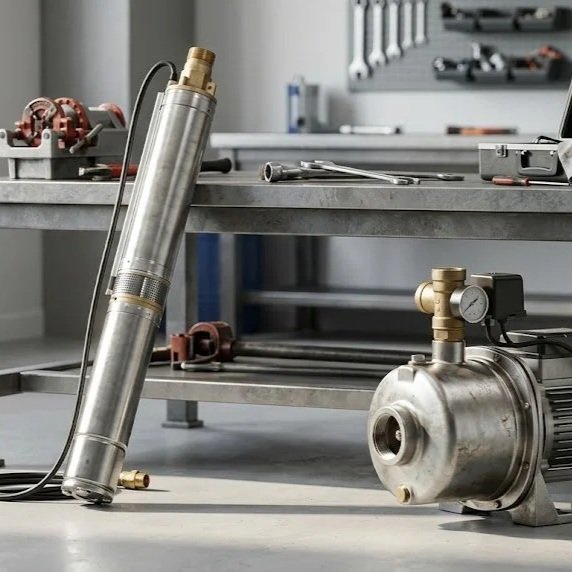
A submersible pump is a sealed, cylindrical unit that sits inside the well casing, fully underwater, often far below the surface. Instead of sucking water up, it sits in the water and pushes it upward through the drop pipe to the surface, and pushing is far more effective than pulling over long distances, which is why submersibles handle deep wells well. Because the motor is sealed and submerged, these pumps run quietly and efficiently, and you won't see or hear them from above; the only clue at the surface is usually the well cap and the pressure tank.
The trade-off is access. When a submersible pump needs service, it has to be pulled up out of the well on its pipe and wiring — a job that takes the right equipment and is firmly professional work.
How a Centrifugal (Jet) Pump Works
A centrifugal pump, commonly a jet pump in well applications, sits above ground — in a well house, garage, basement, or pump shed near the well. It creates suction to draw water up from the well to itself, then pressurizes it for the house. Because it relies on suction, and suction can only lift water so far, this design suits shallower wells. You can see and hear a jet pump running, which makes it easy to recognize and convenient to access for service since it isn't down a well.
Jet pumps come in shallow-well and deep-well versions, but in general, the centrifugal/jet approach is associated with shallower water than a submersible.
Telling Which One You Have
| Feature | Submersible Pump | Centrifugal / Jet Pump |
|---|---|---|
| Location | Inside the well, underwater | Above ground, near the well |
| How it moves water | Pushes water up | Pulls water up by suction |
| Best for | Deeper wells | Shallower wells |
| Visible above ground? | No — only well cap and tank | Yes — you can see and hear it |
| Noise | Quiet (submerged) | Audible while running |
| Service access | Must be pulled from the well | Accessed above ground |
The easiest way to tell at home: go look near your well and pressure tank. If there's a visible pump unit above ground that hums when water runs, you almost certainly have a centrifugal/jet pump. If the only things you see are the well cap and the pressure tank — with nothing visibly pumping — your pump is most likely submersible, working out of sight down in the well.
Why the Difference Matters for Service
Knowing your pump type shapes what a repair involves. A jet pump problem is usually accessible — the unit is right there for inspection, service, or replacement. A submersible problem means the pump has to be pulled from the well, which is more involved and is why submersible diagnosis leans on reading the system's behavior (pressure, electrical, water level) before committing to a pull. The two types also have different common failure points, so identifying the type points a technician toward the likely culprits faster. Either way, a well professional can confirm your pump type and handle the service that matches it.
Frequently Asked Questions
Look at the equipment near your well and pressure tank. If you see and hear a pump unit running above ground, it's a centrifugal or jet pump. If the only visible equipment is the well cap and the pressure tank, with nothing obviously pumping, your pump is almost certainly submersible and located down inside the well. The presence or absence of a visible, audible pump up top is the simplest tell.
Neither is universally "better" — they suit different wells. Submersible pumps excel at deeper wells and run quietly and efficiently because they push water up from below. Centrifugal/jet pumps suit shallower wells and are easier to access since they sit above ground. The right pump depends mainly on your well's depth and water level, which is why the choice is matched to the specific well rather than picked by preference.
Because pushing water is far more effective than pulling it over long distances. A submersible pump sits in the water and pushes it up the drop pipe, which works well even from great depth. A centrifugal pump relies on suction to pull water up, and suction can only lift water a limited height before it stops working. That physical limit is why deep wells use submersibles and shallow wells can use jet pumps.
It's less accessible, which changes the approach. Because a submersible pump sits underwater deep in the well, servicing it means pulling it up out of the well on its pipe and wiring, which requires proper equipment. A jet pump, sitting above ground, is easier to reach and inspect. Technicians often diagnose submersible issues by reading the system's pressure, electrical, and water-level behavior before pulling the pump.
Yes. The two designs have different common failure points and symptoms because of how and where they operate. For example, a jet pump can lose its prime and suction, while a submersible's sealed motor and deep position bring their own typical issues. Knowing the pump type helps a technician zero in on the likely causes faster, which is one reason identifying your pump is a useful first step.
Know Your Pump, Understand Your Well
Submersible and centrifugal pumps solve the same problem from opposite directions — one pushes water up from inside the well, the other pulls it up from above ground — and that drives the differences in depth, noise, visibility, and service. The fastest way to know which you have is to look near the well: a visible, humming unit means jet/centrifugal, while just a well cap and tank means submersible. Knowing the type helps you understand your system and makes any service call clearer and quicker.
Not sure which pump your well uses or what it needs? — Get an expert assessment and service matched to your exact well setup. Pump Repair Services serves Orlando, Winter Park, Apopka. Call (407) 625-5499.